
Understanding Roxy Music
I should perhaps translate my Swedish post on Bryan Ferry. Most books about Roxy Music are stuck in the general understanding I there questioned. The most extreme is the British novelist Michael Bracewell’s Re-make/Re-model: Art, Pop, Fashion and the Making of Roxy Music, 1953-1972 (2007), published, like several similar books in recent decades (as I remember it), by Faber & Faber; but the general interpretation is not very different from Paul Stump’s in Unknown Pleasures: A Cultural History of Roxy Music (1998). Bracewell is also the author of Roxyism (2004).
 1972 was the year of Roxy’s debut album, so what the Bracewell’s 2007 book deals with is their prehistory only. “Re-make/Re-model“, Amazon advertises, “tells the extraordinary and largely unknown story of the individuals and circumstances that would lead over a period of almost twenty years to the formation of Roxy Music – a group in which art, fashion and music would combine to create in the words of its inventor, Bryan Ferry, ‘above all, a state of mind’…Written with the assistance, for the first time, of all of those involved, including Bryan Ferry, Brian Eno, Andy Mackay and Phil Manzanera; the fashion designer Antony Price, the founding guru of Pop art, and Bryan Ferry’s tutor, Richard Hamilton, and many more, Re-make/Re-model is also the account of how Pop art, the avant garde underground of the 1960s, and the heady slipstream of London in the Sixties was transformed into the fashion cults of revivalism, nostalgia and pop futurism in the early 1970s.”
 Although the author exaggerates, it is true of course that Roxy did develop to some extent out of the currents and the general milieu he describes. It is also true that they themselves still sometimes reconnect to them for various reasons. And I am not saying that murk is unimportant or insignificant in this context. But as all those defending the Bracewellian image of Roxy are well aware, this is not the whole story. Although there remains much that I disapprove of, there is also an alternative, immanent telos present in their – and particularly Ferry’s – development, a different side clearly discernible as a potentiality even on the fist, 1972 album, and pointing in a different direction. My argument (the post dealt with both Ferry and Roxy) was that this other side, even if imperfectly fruitioned, is misunderstood and wrongly dismissed, and that in reality it accounts for the strength also of the earliest Roxy albums.
The transformation into “the fashion cults of revivalism, nostalgia and pop futurism in the early 1970s” which Bracewell speaks about is at least one key to understanding this. Revivalism, nostalgia and pop futurism is not a full and adequate description of the alternative telos, but the progression towards the latter, or the continued realization of the alternative potentialitity, the next major step (after the eponymous debut album) in which was taken with the Stranded album (1973), could be conceived as a further development of what began as this transformation. The studied tastelessness of the early albums, and not least the album covers, gradually gives way to something that at least to some extent aspires to be taste (to what extent it succeeds is, admittedly, an open question).
I have several times explained that I find a more proper kind of criticism of these genres of music important, criticism with some other perspectives and with different criteria from the ones this far dominant. But it could certainly be argued that the subject is not important enough to devote time to a translation of the Ferry post, which was written in response to some critical comments on the presence of YouTube-clips with Ferry in this blog. And keeping things in perspective, with a proper sense of the relative weight of what we are dealing with here, it might be considered enough, at least for now, to simply signal that there is a critical rationale of this relatively complex kind behind my continuing to post Roxy and Ferry posts now and then. The rationale is complex relative to the ones behind my posting of music in other genres – like progressive rock, or opera – which are not such as to require the complexity. If Roxy’s genre should be represented here at all, they should be represented.
Roxy Music: Sentimental Fool
From the album Siren (1975).
Charles Joshua Chaplin – Academic Paintings
Kindle Book by Daniel Ankele and Denise Ankele
Ankele Publishing, 2011 Amazon.com
Book Description:
 CHARLES JOSHUA CHAPLIN Art Book contains 30+ Reproductions of portraits and genre scenes with title,date and interesting facts page below. Book includes Table of Contents, thumbnail gallery and is formatted for all Kindle readers and Tablets (use rotate and/or zoom feature on landscape/horizontal images for optimal viewing).
BORN: June 8, 1825 in Les Andelys, Eure, France. DIED: January 30, 1891 in Paris, France.
MOVEMENT: Academic
INTERESTING FACTS: § In 1840, Chaplin studied at the Ecole des Beaux-Arts in Paris. § Chaplin often visited the studio of fellow Academic painter, Martin Drolling. § In 1845, he entered the salon with his Portrait of the Artist’s Mother. § Chaplin taught art classes exclusively for women at his studio. Among his students were Mary Cassatt and Louis Jopling.
NOTABLE WORKS: A Beauty with Doves, Girl with a Nest, Reverie, The Big Sister, The Soap Bubbles, A Song Silenced.
–
See also:
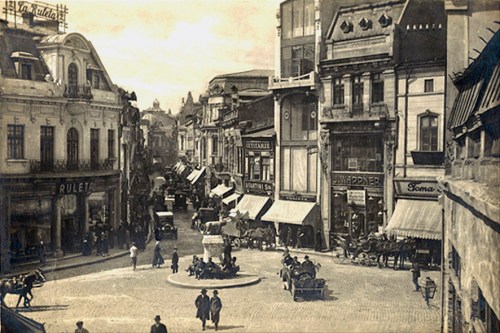
Lipscani, Bucharest
Tidskriften Contextus
Tidskriften Contextus – Forum för konservatism utgavs under 1990-talets sista år men är idag tyvärr förbisedd och sällan nämnd. Den förtjänar, tycker jag, att nämnas oftare.
I den medverkade Johan Sundeen, Carl Johan Ljungberg, Patric Rylander, Hans Wallmark, Per-Olof Bolander, Fredrik Haage, Per Landgren, Halil Magnus Karaveli, Stig Strömholm, Alexander Andrée, Tobias Harding, Carin Stenström, Per Dahl, Erik Kristow, Stig Lundgren, Peter J. Olsson, Lennart Sacrédeus, Christian Braw, Peter Norberg, Claes G. Ryn, Bo Frank, Jonas De Geer, Emil Uddhammar, Lars F. Eklund, Martin Tunström och andra svenska skribenter i olika generationer som gjort sig kända som i åtminstone någon mening och i någon grad konservativa. Redaktörer var Rylander, Anders Broberg, Sundeen, Haage och Tunström.
Tidskriften upphörde ungefär samtidigt som De Geer och Bolander började utge Samtidsmagasinet Salt. Det hade, tror jag, varit bra om de två redaktionerna och grupperna av skribenter kunnat förenas till en gemensam satsning.
Contextus hade behövt en skärpning, fördjupning och vidareutveckling i vissa frågor, och även en vidgning, inte minst på kulturens område, bortom ett ibland alltför begränsat och förutsägbart “borgerligt” (jag är trött på över- och idag närmast rena felanvändningen av detta begrepp i Sverige) perspektiv – något som vad som blev Salt-gruppen med dess delvis annorlunda inriktning i åtminstone någon utsträckning skulle ha kunnat bidra till. Samtidigt hade Salt i hög grad och i flera avseenden behövt Contextus-redaktionens balans och moderation.
Antingen skulle Salt-kretsen i stället för att starta en ny tidskrift ha kunnat stanna kvar hos – och de nytillkomna ansluta sig till – Contextus och bidra till att utveckla och förstärka den med sina nya resurser, eller så skulle Contextus-redaktörerna ha kunnat lägga ned sin tidskrift och övergå till Salt.
Någon sådan förening kom inte till stånd. Jag är rädd att fortfarande, och just på grund av de respektive brister och svagheter jag antytt, tyvärr varken de gamla Contextus- eller Salt-redaktörerna delar min uppfattning att den hade varit önskvärd. Men vad de inte kan förneka är att båda tidskriftssatsningarna havererade och att vi ännu saknar den konservativa kulturtidskrift med samhällsperspektiv som så väl skulle behövas (Axess håller, som jag tvingats konstatera, inte längre måttet). Tradition & Fason var en förtjänstfull senare motsvarighet på nätet, men förutom att uppvisa samma typ av begränsningar som Contextus blev även den kortlivad.
Jag rekommenderar hursomhelst ett besök i det arkiv med ett urval artiklar från Contextus som Konservativt Forum tillhandahåller.
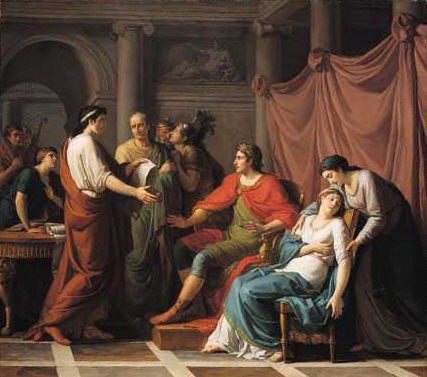
Jean-Joseph Taillasson: Virgile lisant l’Énéide à Auguste et Octavie
Evola on the Adequacy of the Term “Right”
In my post Renaming the New Right, I wrote: “On a general level, it must be said that both the term conservatism and the term Right are philosophically and historically inadequate. Insofar as the term Right is ever associated with the French National Assembly during the revolution, there is, at the very least, something disproportionate even in an Evola’s use of the term ‘the true Right’ for the uncompromising, integral ‘traditionalist’ position as he conceives it.”
This gave the wrong impression that Evola was not himself aware of this problem. I would therefore like to cite a passage from Il fascismo: Saggio di un’analisi critica dal punto di vista della Destra (1964) in French translation (see my comment on my use of French translations of Evola here; in this case, there is to my knowledge not yet any English translation), where he identifies precisely the problem I had in mind:
“En toute rigueur, par rapport à ce que nous avons en vue et qui constituera notre point de référence, le terme de ’Droite’ est impropre. Ce terme, en effet, suppose une dualité: la Droite, pratiquement, se définit dans le cadre du régime démo-parlementaire des partis, par opposition à une ‘gauche’, donc dans un cadre différent du cadre traditionnel des régimes précédents. Ces régimes connurent tout au plus un système sur le modèle anglais dans ses formes originelles pré-victoriennes, c’est-à-dire avec un parti qui représentait le gouvernement (et celui-ci était, d’une certaine façon, la Droite), et une opposition, non pas comprise comme une opposition idéologique ou de principe, une opposition au système, mais comme une opposition dans le système (ou la structure) avec des fonctions de critique rectificatrice et intégratrice, sans que fût mise en question, de toute namière, l’idée, en quelque sorte transcendante et intangible, de l’État. Une telle opposition ‘fonctionelle’, bien délimité dans un contexte organique et toujours loyaliste, n’a rien à voir avec l’opposition que peut exercer tel ou tel des multiples partis, chacun pour son propre compte et voué à la conquête du pouvoir et de l’État, si ce n’est à l’institution de l’anti-État…Il faut donc concevoir la Droite, prise dans son meilleur sens, politique et non économique, comme quelque chose de lié à une phase déja involutive, à la phase marquée par l’avènement du parlementarisme démocratique avec le régime des nombreux partis. Dans cette phase, la Droite se présente fatalement comme l’antithèse des différentes gauches, pratiquement en compétition avec elles sur le même plan. Mais elle représente en principe, ou devrait représenter, une exigence plus élevée, elle devrait être la dépositaire et l’affirmatrice de valeurs directement rattachées à l’idée de l’État vrai: valeurs d’une certaine manière centrales, c’est-á-dire supérieures à toute opposition de partis, selon la supériorité comprise dans le comcept même d’autorité ou de souveraineté pris dans son sens le plus complet.” (Le fascisme vu de droite suivi de Notes sur le Troisième Reich (1993 (1981)), 15-16.)
What Evola has “en vue”, his “point de référence”, i.e. what I called “the uncompromising, integral ‘traditionalist’ position as he conceives it”, he considers it legitimate to describe in this context in terms of “la grande tradition politique européenne, non en pensant à un régime particulier comme modèle, mais bien à certaines idées fondamentales qui, en mode varié mais constant, ont été à la base de différents États”. (15)
It is likely – I cannot remember right now – that he has remarked on the inadequacy of the term Right and even true Right for this tradition and these “idées fondamentales” in other works too, most likely perhaps in Gli uomini e le rovine (one of the many works now published in English translation by Inner Traditions, Men Among the Ruins), to which he makes reference in this same chapter in Il fascismo for a systematic exposition of his doctrine of the state. I happened to find it now in the latter book, and the passage cited gives a sufficient account of his perception of the problem.
Having thus clearly explained the inadequacy of the term Right, Evola still chooses to use the term the true Right, and concludes by saying that “idéalement le concept de la vraie Droite, de la Droite telle que nous l’entendons, doit être défini en fonction des forces et des traditions qui agirent d’une maniére formatrice dans un groupe de nations et parfois aussi dans des unité supranationales, avant la Révolution française, avant l’avènement du tiers état et du monde des masses, avant la civilisation bourgeoise et industrielle, avec toutes leurs conséquences et les jeux d’actions et de réactions concordantes qui ont conduit au marasme actuel et à ce qui menace d’une destruction définitive le peu qui reste encore de la civilisation européenne et du prestige européen”. (17)
It might be said that speaking of the true Right does not remove the problem, when Evola has correctly defined the Right in historical terms. There is, it could be said, nothing “false” about the Right thus defined, since it simply is what the Right is. It is the true Right. En toute rigueur, the term true Right is therefore also impropre. What could at the most be said, it might seem, is that what Evola means to say is that there ought to be another Right, distinct from the real, historical Right, an alternative Right which truly defends and upholds the pre-right order which Evola calls the true Right.
But then it appears Evola does think there has been at least periodically in the historical Right, and, it would seem, even within “le cadre du régime démo-parlementaire des partis”, something similar to his true Right, something that has in fact not been exhaustively defined by that cadre and the “opposition à une ‘gauche’” in substantial terms by, most fundamentally, simply accepting their legitimacy. The “false” Right is then for Evola that which allows itself to be defined by the new duality of the “régime démo-parlementaire”, while the true Right is that which somehow resists or tries to resist it and to defend the pre-Right regime and its principles.
Much needs to be said of course about the relation between the “true right” thus defined and modernity, and not least what I prefer to speak of as an “alternative modernity”, an area where, as I have explained elsewhere, my understanding is in some important respects different from that of what Mark Sedgwick, introducing an important distinction, calls the “hard” traditionalists. But here the question is only the very limited one of the appropriateness of the terms Right and true Right; I wanted to do justice to Evola’s own reasoning and his awareness of the problem I mentioned in my earlier post.
Alte Nationalgalerie, Berlin

Terry Eagleton on Marx
I recently posted a public debate between Roger Scruton and Terry Eagleton at the Royal Institution in London last year. It seemed to me Eagleton had changed. Scruton himself hinted at this in the debate.
This was also confirmed when I read his recent, short book Why Marx Was Right (2011). It is the first book I have read about Marxism – including Marx’s own – which did not immediately strike me as presenting a system of thought and historical analysis that, while containing important partial truths, is almost absurd in its onesidedness and reductionism. It seems to me this is not Eagleton’s own Marxism as I first encountered it long ago.
Eagleton sets out to refute what he claims are the misunderstandings of the critics of Marxism. What he overlooks is that these misunderstandings are quite as much those of the Marxists themselves, of Marx’s own followers. But it is clear that what we have to do with here is a Marxist who has actually understood and absorbed criticism of Marxism from positions that used to be ignored and dismissed a priori. And this seems to be the result of a process of development of personal maturity, including deepened historical reflection. The nature of Eagleton’s defence of Marx strongly suggests that this could not have been achieved without his primary scholarly orientation, namely literature and the history of literature. As he says in the debate with Scruton, he has taught Shakespeare all of his life – and he has also of course written about him. Living with the classics during a long career does have its effects, even, in many cases, when that career is devoted to ideological reinterpretation.
It is highly significant that, in the book, Eagleton uses Scruton’s own formulation – several times repeated in his works – about the Communist Manifesto and Marx’s philosophy of history as there expressed. Eagleton does in fact also criticize Marx on a few points.
But it could, it seems to me, be argued that although he often does succeed in defending Marx against both critics and Marxists, what he primarily does is to present his own, more tenable version of Marxism, rather than defend Marx as he is. And he does it at least partly because he has finally realized the weight of and the need to assimilate kinds of criticism which were previously for the most part simply not understood at all among Marxists. One after another, most of the main points are taken up, in the way one always thought Marxists should have had the intelligence to do it long ago.
All of them are not taken up, and the defence is in many cases far from sufficient with regard to the ones that are. And quite apart from philosophical considerations, it seems far too late to save Marxism as such in a new and more reasonable form. Moreover, he still does not seem to have fully absorbed the Hegelian and phenomenological versions of Marxism, culminating perhaps in the work of Karel Kosík, which I always found to be philosophically the most important and tenable, although it was important and tenable not because of its specifically Marxist content but because of its retention, partly inspired by the early, “pre-Marxist” Marx (Kosík emphatically denied that this Marx was pre-Marxist), of central elements of idealism. As I said, all presentations of Marxism struck me as absurd in its basic philosophical premises, and although post-Marxism and postmodernism had already for a long time been overshadowing and even replacing it, at the time I started my academic studies one still, at least in the historically oriented humanities, had to go through and thoroughly familiarize oneself with most of its main currents.
Eagleton’s book is not a good introduction to Marx. He is still far too deeply absorbed in the erroneous positions of Marx and the general radical main current of modernity to be able to see clearly the nature of Marx’s thought and the currents in which he too was caught up. Most of the vast and fundamental issues here involved are still simply ignored, or, more precisely, simply not perceived by Eagleton.
But in some respects it is a better introduction to Marx than any other I have read (I should emphasize that it is not an extensive, scholarly work but only a brief essay presenting the outline of a defence). I remember how, when I was a young student, Marxists used to praise certain introductions to Marxism as brilliant, and how they seemed to think they must almost of necessity convince the reader. I found this totally incomprehensible. The effect they had on me was the opposite: they immediately made me see the monumental untruth of Marxism, and this impression was not changed by deeper familiarity with Marxism. They said all the things Eagleton now says Marx does not say, and often in a studiedly provocative manner which revealed everything about the true nature and motivation of their authors.
Many decades after the heyday of Marxism, Eagleton seems in these respects different indeed. With him, it is clearly possible to have an intelligent and meaningful discussion – which is what Scruton does, albeit somewhat awkwardly, having in the past had reason to sharply criticize his interlocutor.
If time allows, I will develop my argument here into a series of posts, in which I go through Eagleton’s main arguments in defence of Marx and emphasize what is new and important in them. Defending almost the entirety of Marx’s work or his positions is an impossible task, and Eagleton of course does not succeed in this. But what could be regarded as the in reality most important contribution Eagleton makes in Why Marx Was Right is that he facilitates the rescue, as it were, of Marx’s important partial truths. These seem, it seems to me, in some cases more easily assimilable by non-Marxists in the form in which they are here presented than in most other Marxists, and indeed Marx himself.
This rescue is not least important in the face of post-Marxism. For the partial truths of Marx, truths to some extent dissociable from his system as a whole, are the ones often found in his many-layered criticism of capitalism, and what characterizes post-Marxism is not least their loss. Even a (paleo)conservative critic of post-Marxism like Paul Gottfried, who does not focus on Marx’s criticism of capitalism, clearly perceives that post-Marxism is in important respects more problematic than Marxism and far less intellectually rigorous.
We find here a general tendency of convergence between paleoconservative and more or less paleomarxist analyses of post-Marxism. Like Fredric Jameson, Eagleton has, it seems, long criticized the development of post-Marxism (Why Marx Was Right prompted me to read also The Illusions of Postmodernism from 1996), whereby the relative theoretical strength of Marxism is clearly demonstrated and several overlappings with certain kinds of conservative analyses become visible, although at the same time the weaknesses in comparison with such analyses become obvious. Eagleton is always, like Jameson, for many reasons compelled to accept much in post-Marxism in a way a Gottfried is not. Eagleton and Jameson are simply part of the general, broader and deeper dynamic of modernity, the nature of which cannot be properly grasped from inside of it.
Of course, some branches of Marxism were always supported by capitalists, since the effects of the general cultural radicalism promoted by such branches and indeed in many cases socialism itself are in the interests of capitalists. But in post-Marxism, we tend to see a wholesale adoption on the part of the left of the long-standing schemes of global capitalism. With only few remaining exceptions, the left has become its faithful supporters and promoters, and not least much more openly funded by it. With Obama, the transformation described by Gottfried of the the anti-Americanism of the European Left into “extreme affection” during the Clinton years has only been intensified.
Unfortunately, Eagleton does not sufficiently distance himself from the current post-Marxist left, the global capitalist left, the American imperialist left, the war left. It remains unclear to me where exactly he stands with regard to the issues I have here briefly indicated. He cannot see things as clearly as Gottfried, a representative of the only real alternative America. But he also cannot see them as clearly as his fellow leftist Jean Bricmont – who wrote Impostures intellectuelles with Alan Sokal and who collaborates with the Chomsky who is now of course increasingly rejected by the left – in this recent mise au point.
Scruton too, being more attached to the old cold-war controversies between left and right (as he understood them) than Gottfried, unfortunately fails to perceive these things. He is, as it were, right in the Royal Institution debate that the left still dominates the universities, while at the same time Eagleton is right that they have been taken over by capitalism. None of them sees, or wants to see, the whole picture.
 Olle Bengtsson