
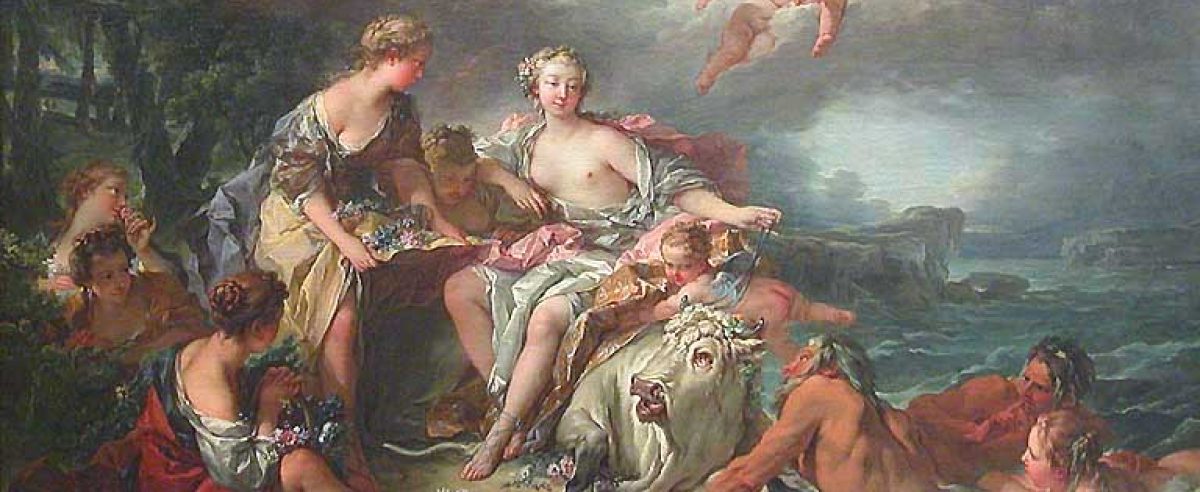
Antonio da Correggio: Il ratto di Ganimede
Filosofins och vetenskapens nya uppbyggnad företas hos Descartes utifrån det ensamma tvivlande och tänkande subjektet som enda kvarstående certum. Om subjektet som det opersonliga tänkandet delvis fortfarande har drag av den aristoteliska anima intellectiva, har det dock en annan uppgift än att vinna kunskap genom att abstrahera fram allmänbegreppen ur tingen. Med uppfattningen av jagets självmedvetna tänkandes innehåll som naturliga, medfödda idéer, genom tanken i sig, som sådan, givna sanningar, genomför Descartes också den nya tidens psykologiska och epistemologiska användning av termen idé: den börjar betyda föreställning och medvetandeinnehåll i allmänhet, och närmare bestämt det som återstår efter det metodiska tvivlet och som kan analyseras som innehåll i cogitatio.
Skillnaden mellan Augustinus och Descartes ligger främst i Descartes’ förnekande av vad Taylor kallar det “ontiska logos” som Augustinus ännu bejakar. Det ontiska logos, motsvarande den klassiska idéläran med dess “self-revealing reality”, ersätts i den nya tidens vetenskap av uppfattningen av kunskap som föreställning eller “representation”. Det är dessa föreställningar som nu benämns idéer, och de är inte blott belägna inom subjektet, utan deras ordning och sammanhang är också något som till skillnad från de klassiska idéernas, som helt enkelt återfinnes eller upptäcks av subjektet, nu också konstrueras av subjektet självt. [Sources of the Self (1989), 144-45.]
Cusanus’ lära om vis assimilativa utvecklas hos Descartes till läran om cogitatio – Taylor (som dock tyvärr förbiser Cusanus) framhåller hur redan Augustinus framlyft det etymologiska sambandet mellan cogitare och cogere (samla, sammanställa, sammanhålla). [Ibid. 539, not 4.] Vetenskaplig kunskap är kunskap om eller kunskap möjliggjord av “klart och tydligt” förnumna, och därför sanna, sådana idéer. Föreställningarnas sanning är givna med deras évidence. Bevetenhetens innehåll är för Descartes inte givet genom illumination, utan med det mänskliga tänkandet självt.
Med den klassiska idélärans förkastande förändras, framhåller Taylor, kriteriet för människans rationalitet och själens inre ordning från överensstämmelse med idéernas ytterst av det Goda bestämda ordning till evidensen hos de egna idéerna och deras metodiskt, systematiskt organiserade verklighetsrepresentation: rationaliteten “is no longer defined substantively, in terms of the order of being, but rather procedurally, in terms of the standards by which we construct orders in science and life…For Descartes rationality means thinking according to certain canons. The judgement now turns on properties of the activity of thinking rather than on the substantive beliefs which emerge from it.” [Ibid. 146 f.]
Detta är det nya fokus på la méthode. Naturligtvis menar Descartes att “his procedure will result in substantively true beliefs about the world”. Men detta är “something which has to be established…We make the link between procedure and truth with the proof that we are the creatures of a veracious God…Rationality is now an internal property of subjective thinking, rather than consisting in its vision of reality…The move from substance to procedure, from found to constructed orders, represents a big internalization.” [Ibid. 156.]
Men fokuserande på interioriteten vill Taylor ändå fortfarande lägga stor tonvikt på likheten och kontinuiteten med Augustinus: “Plainly the whole Cartesian project owes a great deal to its Augustinian roots”. [Ibid.] Men att tala om hela projektet här känns kanske litet överdrivet; skillnaderna är väl lika uppenbara.
Model
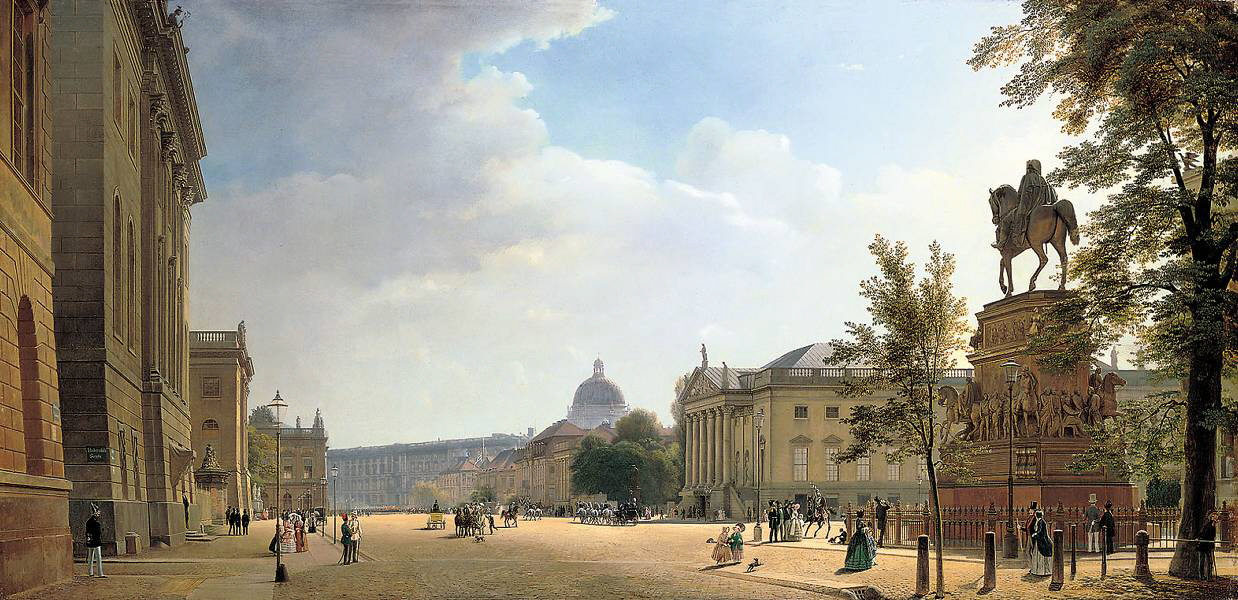
Det gamla Berlin var utan tvekan en mycket vacker stad, bekräftade jag i ett svar idag på morgonen på en bra kommentar av ”Fredrik” till föregående post med Gaertners målning av Unter den Linden – ett svar som, inser jag nu, blev tillräckligt långt för att utgöra ett nytt kort inlägg av samma typ som mitt tidigare om Bukarest.
Tyvärr, fortsatte jag, byggdes inte mycket upp igen efter kriget. I Dresden och Leipzig rekonstruerades mer, och i Warszawa på enastående sätt hela den äldsta delen (samtidigt som kommunisterna i båda länderna dock inkonsekvent rev annat, exempelvis Augusteum i Leipzig). Men just de delar av Unter den Linden som återges i Gaertners målning byggdes upp på femtio- och sextiotalet och kan fortfarande beskådas i verkligheten. Dock ännu ej slottet som syns i fonden. Det klarade sig genom kriget, men sprängdes – liksom det anrika hotell Adlon vid Pariser Platz i andra ändan av Linden – av den sovjetiska ockupationsmakten efter kriget. Beslut har dock fattats om att också det ska återuppbyggas.
Men vad man nästan allra mest saknar i Berlin är den mer vanliga 1800-talsarkitekturen, som inte ansetts tillräckligt värdefull för att återuppbyggas ens i begränsad utsträckning. Detta är ett generellt problem i hela Europa, som snabbt måste lösas. Fortfarande förstörs barbariskt och i snabb takt denna arkitektur över hela kontinenten.
Det var den som gav Berlin mycket av dess allmänna skönhet. Enstaka sådana överlevande hus och kvarter finns kvar över hela staden, i Kreuzberg stora områden. De fick stå kvar, men principen för efterkrigstidens återuppbyggnad var ju radikalmodernismens programmatiska historielöshet. Och den militanta historielösheten har inte övergivits, utan tvärtom ytterligare skärpts. Postmoderna och post-postmoderna monstruositeter tillkommer överallt i rasande takt, med Potsdamer Platz som det mest horribla exemplet.
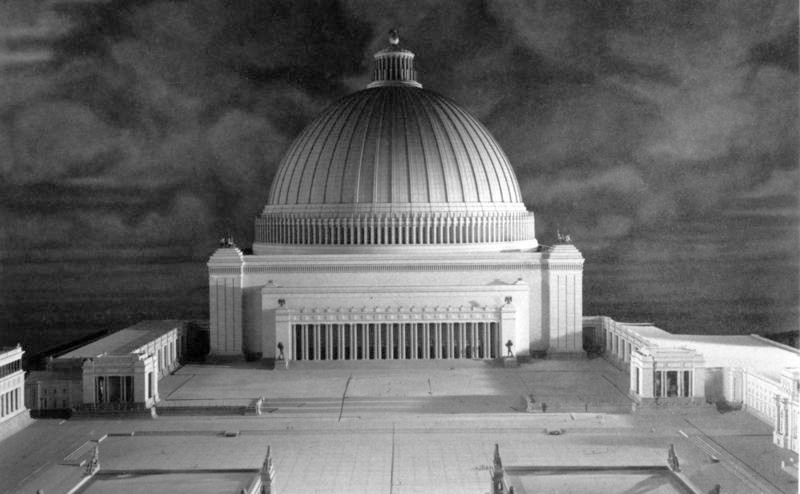
Redan före kriget hann den nationalsocialistiska regimen riva en del äldre bebyggelse – för att ge plats åt det nya “Germania”, dominerat av den oproportionerligt stora Große Halle eller Volkshalle (riksdagshuset och Brandenburger Tor var tänkta att bevaras alldeles intill den). Också detta var naturligtvis feltänkt. Att Speers arkitektur var mer värdefull än vad som efter kriget byggdes – även på den del av Linden som inte syns på Gaertners målning – är inte ett tillräckligt skäl att låta sådant ersätta arkitektur av Lindens eller ens Kurfürstendamms slag. Det måste byggas någon annanstans, om det överhuvudtaget måste byggas. Jfr mina argument rörande Bukarest.
Mitt förslag är att man härnäst, efter slottsprojektet, i första hand inriktar sig på att riva efterkrigsbyggnaderna på Ku’damm, liksom man redan rivit DDRs hemska Palast der Republik på platsen för slottet, och återuppbygger denna aveny som var nästan lika magnifik som Linden.
Dock är sådan precis historisk rekonstruktion som ifråga om enstaka särskilt viktiga historiska byggnader naturligtvis inte alltid nödvändig. Möjlighet finns ju också till historisk förbättring inom den nyskapande traditionens ram. Nybyggnad som kreativt vidareför, varierar och vidareutvecklar de historiska stilarna är generellt välkommen – framtidens nödvändiga arkitektur.
Click to enlarge
Idealism and the Renewal of Humanistic Philosophy, 1
Idealism and the Renewal of Humanistic Philosophy, 2
Scientism was thus correctly criticized by philosophical currents deeply shaped by romanticism, even when as alternatives these were not in themselves tenable due to the problems precisely with this romanticism. The analytic philosophy which turned against and replaced idealism was a militantly scientistic philosophy, and still tries, even if only awkwardly, to be so. Much of romantically inspired “continental” philosophy was sometimes correctly criticized by analytic philosophers even as their alternative was not in itself tenable either, due to the problems with its scientism. But primarily because of the latter problems, the sharp demarcation line between analytic and continental philosophy has for a long time and in many respects been blurred.
This is not always because analytic philosophers relinquished their scientism and continental philosophers their romanticism. Again, on a deeper analysis, we have to do with two expressions of the same underlying cultural dynamic, and thus there were, not surprisingly, instances if not of the potential of synthesis, at least of a characteristic combination. But to the extent that such relinquishing of untenable elements – whether because of the criticism from the other side taking effect or for other reasons – was the reason why the line was blurred, the blurring was welcome.
Some philosophers call for further mutual modification of the analytic and continental traditions. The former has to recognize and assimilate the central humanistic, historical, and hermeneutic concerns of the latter, while the latter is held to stand in need of the formal and conceptual clarity and rigour of the former. It is difficult to see how anything like this is possible without discarding completely the scientistic substance of the analytic project. But to the extent that an interpenetration of the two traditions leads to a mutual modification which does involve this, it is certainly of the greatest historical and intellectual significance. That continental philosophy was not always what the analytic philosophers said it was has always been obvious, and that analytic philosophy can be disconnected as a set of formal instruments from its scientistic substance has of course also long been clear, and is exemplified today not least by analytic philosophical theology and “analytical Thomism”.
Idealistic philosophy was part of a whole cultural paradigm in many countries, which, in the eyes of the radical critics, shaped by the incipient general, post-World War I twentieth-century sensibilities, often made its positions wrongly appear conservative and almost “traditional” in my sense, constituting as it did one major expression of the Victorian spirit, its moralism, and its aesthetics, and symbolizing much of the world before the rise of high modernism and the general cultural radicalism shared, for all of their differences, by the logical positivists, Bloomsbury, the Marxists, the Freudians, and many others. Idealism seemed to represent the lost world of the nineteenth century. Defending it in the Britain of Lytton Stratchey required new and different talents. Defending it in terms of that Britain, or as to some significant extent part of it, was from the beginning a project of poor prospects.
Yet in some more and less obvious ways, nineteenth-century idealism did in fact live on. There were idealists here and there, and idealism’s nineteenth-century legacy contributed important elements to the work of the few non-analytic or, possibly, non-scientistic analytic philosophers in Britain and America, and even more to continental philosophy. Typically, however, idealism was conspicuously absent from the analytic-continental controversy. Both camps considered themselves “post-idealist”. Under the influence of, for instance, Heidegger’s criticism of the epistemology of neo-Kantianism, historicism, and earlier forms of hermeneutics in the case of continental philosophy, and, again, simply of scientism in the case of analytic philosophy, both long tended to forget or play down the idealist themes of modern philosophy of history, art, action, science, and language.
Today, the contributions of idealism in these areas, and elsewhere, are becoming more visible. Not least for the purpose of a modified reconstruction of the “subject”, including but also transcending epistemology, continental philosophers more consciously take up greater or smaller elements of idealism, often with a thorough historical knowledge of its traditions, but also sometimes without critical discernment, and adding some of the problematic twentieth-century assumptions. Some philosophers at least trained in the analytic tradition take up various idealist positions, but, it seems, often from outside, as it were, without the full idealist understanding of experience, reason, or the role of philosophy. It is time, I think, to pay attention not only to the scattered idealist themes and positions that appear here and there in contemporary philosophy, and to not only rediscover idealism’s contributions to and influence on later and other philosophies, but to renew something of the more integral vision of idealism. In the respects mentioned here, the twentieth century is over.
As selectively reappropriated, idealism could, I suggest, contribute both to the completion of the mutually modifying interpenetration of the analytic and continental traditions as I have outlined it, and, simultaneously, to the process of transcending them both. For when some misunderstandings in the criticism of idealism have been cleared up, it might be possible to see that idealism can supplement and indeed in the most central respects supplant both, not least through a broader and deeper view of reason and of objective truth which, for different reasons and with different but equally characteristic consequences, they have both lost.
As disentangled from the pantheistic revolution, idealism is a badly needed moderating force in secular modernity which, I contend, should be embraced in its unabridged anti-naturalistic and anti-physicalist import. The need is for a non-reductive spiritualism.
Teori i svensk idé- och lärdomshistoria, 1
Teori i svensk idé- och lärdomshistoria, 2
Teori i svensk idé- och lärdomshistoria, 3
Teori i svensk idé- och lärdomshistoria, 4
Teori i svensk idé- och lärdomshistoria, 5
Det s.k. postmoderna tillståndet innebar förvisso positivismens upplösning, och naturligtvis i själva verket delvis också, fastän de politiska intressenas kontinuitet ofta dolde detta faktum, upplösningen av den dels alltför ensidigt förstådda, dels gradvis sig upplösande historiematerialism och strukturalism som låg till grund för ideologianalysen.
Den relativistiska avgrund som nu öppnar sig, den nihilistiska maktkamp mellan intressegrupper som hotar att ta över vetenskapens fora och institutioner och som förnekar eller åtminstone inte orkar försöka teoretiskt förstå och klargöra vad som är objektiv vetenskaplighet, riskerar att medföra att den humanistiska forskningens legitimitet (den naturvetenskapligt-tekniska kommer alltid, av uppenbara skäl, att klara sig), när den inte helt vill böja sig för den politiska maktens och det borgerliga samhällets intressen, ifrågasätts. Det kommer, hoppas jag, att bli alltmer nödvändigt för den humanistiska forskningen (och undervisningen) att våga ta sig an dessa vetenskapsteoretiska frågor och att arbeta sig fram till en hållbar filosofisk förståelse av den egna vetenskapens och vetenskaplighetens natur som kan tjäna som försvar och legitimation och helst än mer än så.
Jag håller vidare med såväl den gamla marxismen som den nya postmodernismen om att vetenskapen inte kan helt eller kanske ens till någon större del isoleras från politiken o.s.v. Men jag gör det från delvis andra teoretiska utgångspunkter, från andra filosofiska ståndpunkter, med en annan vetenskapsförståelse och ”universitetsideologi” – och därför också med andra slutsatser.
Explicita anspråk utifrån den göteborgska ideologianalysen själv på att det distinkta urval och den bestämda kombination av historiskt föreliggande idéer som den anser vara sanna och värdefulla är konstitutiva för vetenskapligheten, skulle framstå som något förfelade. Av olika skäl har det dessutom i allt högre grad kommit att heta som i slutet av Schmidts uppsats: ”Den vetenskapssyn som hittills varit förhärskande förbehåller inte sig själv ensamrätt över benämningen idéhistoria. Utan att hemfalla åt relativism eller ett liberalt pluralismideal medför transitiviteten i själva form och innehållslogiken öppenhet, liksom den i det ideologianalytiska perspektivet inneboende självreflexiviteten medför tolerans. ’Medveten’ om sin egen ideologiska natur ’beskyller’ den inte andra uppfattningar för att vara ovetenskapliga, möjligen bara sämre ideal.” Att här ifrågasätta arten av denna öppenhet och tolerans är naturligtvis överflödigt; poängen är här endast att man inte längre talar i de gamla vetenskaplighetsanspråkens termer. Vi tycks röra oss från en Althusser – eller Althussertolkning – till en annan och mer tidsenlig.
Bortser man från de specifika göteborgska preferenserna det historiska urvalet och kombinationen, kvarstår framför allt i Liedmans uppsats om Aspelin en rad viktiga formuleringar om teorins, eller ytterst filosofins, oundgänglighet i allmänhet och om det idéhistoriska studiets teori/filosofiberoende karaktär. Man lägger också märke till en förmåga till kollegial sämja som trots de i sak oförenliga vetenskapsuppfattningar i allmänhet och uppfattningar av den egna vetenskapen i synnerhet som uppvisas av Liedman och Schmidt (och även Olausson) å ena sidan och Lindberg å den andra manifesteras i flera av de här nämnda uppsatserna. Den kan vara viktig inte minst därför att den möjligen åtminstone för vissa representanter för de olika lägren ställer i utsikt ett (från de sakligt stridande parternas sida) dialektiskt övervinnande av de respektive ensidigheterna, med deras respektive delsanningar samtidigt uppbevarade – även om en ny verklig syntes i dessa sammanhang s. a. s. måste bli någonting mer än blott en syntes av just dessa moment. Hursomhelst måste man sympatisera med Liedmans tes att ”[d]et är viktigt att klargöra vetenskapliga skillnader där de föreligger utan att dessa skillnader med nödvändighet måste leda till kontroverser. Klargörandet kan rentav förebygga kontroverser eller åtminstone göra kontroverserna både vettigare och kanske t. o. m. vetenskapligt fruktbara” – en tes som Liedman uppställer som en ”norm för gott och fruktbart vetenskapligt umgänge”.
Liedman framhåller också förtjänstfullt (contra David Östlund) hur den aspelinska uppfattningen av idéhistorien skiljer sig från den nordströmsk-lindrothska. Med sina solida metodiska färdigheter, med sitt grundkrav på faktisk historisk lärdom, och med sina stilistiska ideal, förblir den senare traditionen en omistlig del av den svenska idé- och lärdomshistoriska vetenskapen. Sådan den representeras av en Lindberg med hans ”i många stycken gammaldags humanistisk[a] position” (Olausson) framstår den också som alltmer relevant och aktuell. Problemet är emellertid dess ateoretiska karaktär. Den förbisedda möjligheten är att just denna humanistiska position, och den nordströmska traditionens förtjänster, mycket väl låter sig förenas med den goda vetenskapsteori som är ett med en sant humanistisk filosofi. Intressant nog förefaller mig just den aspelinska tradition som förvisso skiljer sig från den nordströmska och som i den ”mest älskade” eleven Liedmans händer blev till den göteborgska ideologianalysen, rymma väsentliga humanistisk-filosofiska moment som mycket väl skulle kunna tillhandahålla en del av det nödvändiga komplementet.
Jag är rädd att Schmidts uppsats har tvingat Lindberg att ompröva sitt erkännande att ideologianalytikerna ändå i mycket bibehållit åtminstone de stilistiska idealen från den nordströmska traditionen. Men här är utan tvekan en balansakt av nöden. Hur skall man kunna föra en kvalificerad teoretisk diskussion om man överhuvud inte får använda de adekvata termerna därför att de innebär stilbrott? Stilen skall vara god och enhetlig och fri från osjälvständig epigonisk jargong och osmält överlastning, men den avancerade teoretiska och filosofiska textens stil, och den historiska framställning som gör bruk av sådan teori, är helt enkelt i mycket bara en annan än den Lindberg har i åtanke. Den är åtminstone inte med nödvändighet och per automatik en dålig stil.
Med sin lära om de två substanserna, tänkandet och utsträckningen, och med sitt nya substansbegrepp överhuvud, upplöser Descartes principiellt den komplexa och motsägelsefulla skolastiska enheten av kropp och själ och söker ett nytt sätt att föreställa sig deras förhållande till varandra.
Liksom Bacon förkastar han den skolastiska läran om substantiella former, d.v.s. sådana former som till skillnad från de “rena” formerna (änglarna – en mellannivå av personlighet mellan “människans” och Guds?) är nödvändigt förenade med materian, och beskriver dem som qualitates occultae. Men samtidigt prisges personbegreppet, eller träder det åtminstone i bakgrunden. Descartes ersätter inte den skolastiska persondefinition enligt vilken personskapet bygger just på kroppens och själens enhet med någon annan. I stället talar han utförligt om Jaget, vars väsen är cogitare: detta jag är, i den individualistiska riktingen av Descartes’ filosofi, en substantiell och individuell själ, och dess “tänkande” fattas hos Descartes i mycket vid mening, som omfattande en stor mängd själsfunktioner.
Viktigt är också att Descartes inte förstår subjektet i den redan av Eckhart och Cusanus på Gud tillämpade “substanslösa” meningen, utan, fastän hans lära om de två substanserna skiljer sig från den skolastiska substansläran, begreppsligt alltfort i mycket även i den klassiska meningen av substans. Det är hos Descartes icke fråga om blott cogitatio, utan om ett tänkande res.
Descartes är också noga med att från detta bortrensa de s. a. s. finfysiska rester – vind, eld, eter – som främst hos stoikerna vidlådde begreppet anima. Av detta skäl börjar han, efter att tidigare ha använt termerna anima och âme (i Discours: “l’Ame par laquelle ie suis ce que ie suis”, “âme raisonnable”), i stället föredra enbart mens och esprit, och på sin höjd animus (i Meditationes: “sum igitur praecise tantum res cogitans, id est, mens, sive animus, sive intellectus, sive ratio”). Hans “själs”-begrepp frigör sig från de i den antika filosofin ofta kvardröjande materiella resterna, men förlorar också egenskapen av livets princip, utan att det framgår varför och hur det senare följer ur det förra.
Men subjektet/jaget identifieras av Descartes endast med den ena av de två substanserna: till det hör alltså inte det som är om inte den väsentligaste så dock en oavskiljbar del av det huvudsakliga skolastiska personbegreppet: den fysiska kroppen. Jaget som “tänkande” väsen, som substantiell själ, som subjekt primärt i förhållande till kroppen och materien, genom själva sin natur och sitt tänkandes innehåll nödvändigt förbundet med Gud: detta var åtminstone delvis nyansatser i förhållande till skolastiken, nyansatser som i vissa avseenden kunde synas gripa tillbaka på en aspekt av den platonska traditionen, förbi kyrksenantikens och medeltidens själsligt-kroppsliga enhetstänkande.
Även här framhåller Taylor – i sitt senare verk A Secular Age (2007) visar han sig också angelägen att finna eller läsa in andlighet i moderniteten – överensstämmelserna mellan Descartes och Augustinus. [Sources of the Self (1989), 141 f.] Ett slags metafysisk klarhet syntes ha vunnits, men samtidigt hade det filosofiska fokus på personbegreppet försvunnit med skolastiken. Och på grund av att både frågan om hur subjektet som individuellt förhåller sig till subjektet som allmänt och frågan om hur de individuella subjekten förhåller sig till varandra förblir outredda, tappar Descartes signifikativt nog också, åtminstone ifråga om andra personer som icke är Gud, bort de ansatser som tidigare funnits att definiera personidentiteten som något som är beroende av andra personer, av relation.


