Eckhart Tolle: The Power of Now

A Guide to Spiritual Enlightenment

New World Library, 1997     Amazon.com (2004, with new preface)

Front Flap:

To make the journey into The Power of Now we will need to leave our analytical mind and its false created self, the ego, behind. From the beginning of the first chapter we move rapidly into a significantly higher altitude where on breathes a lighter air, the air of the spiritual. Although the journey is challenging, Eckhart Tolle offers simple language and a question-and-answer format to guide us. The words themselves are the signposts.

For many of us there are new discoveries to be made along the way: we are not our mind; we can find our way out of psychological pain; authentic human power is found by surrendering to the Now. We also find out that the body is actually one of the keys to entry into a state of inner peace, as are the silence and space all around us. Indeed, access is available everywhere. These access points, or portals, can all be used to bring us into the Now, the present moment, where problems do not exist. It is here we find our joy and are able to embrace our true selves. It is here we discover that we are already complete and perfect.

Many of us will find that our biggest obstacle to this realization is our relationships, especially our intimate relationships. But again, we are in “new territory” and all is not what it had seemed before. We come to see that our relationships are yet another doorway into spiritual enlightenment if we use them wisely, meaning if we use them to become more conscious and therefore more loving human beings. The result? Real communion betwen self and others.

If we are able to be fully present and take each step in the Now, if we are able to feel the reality of such things as the “inner-body”, “surrender”, “forgiveness”, and the “Unmanifested”, we will be opening ourselves to the transforming experience of The Power of Now.

Blurbs:

“I heartily recoomend this profoundly inspiring book to all seekers today.”  Lama Surya Das, author of Awakening the Buddha Within

“A reminder to be truly present in our own lives and liberated from our past and future. It can transform your thinking. The result? More joy, right now!”  O: The OPRAH Magazine

“Tolle has succeeded on two fronts: synthesizing the teachings of masters such as Jesus and the Buddha into an easily accessible guide to achieveing spiritual  consciousness and making a strong case that the inability of humans to free themselves from dominance by the mind and live in the present is the root cause for misery in the world…He makes enlightenment seem attainable and necessary for both individual peace and the health of the planet.”  ForeWord Magazine

“Fresh, revealing, current, new inspiration. Out of the many spiritual books that cross my desk this one stands out from the flock…If you are considering getting back in touch with your soul, thsi book is a great companion.”  Common  Ground

“With intense and compelling clarity, Tolle’s guidance holds the promise of leading us to our own best and highest place within, to resonate with and reflect the energy of true transformation.”  Spirit of Change

“This seems to be the ‘right book’ for many people at this point in time. The writing is clear as a bell; the words ring true. Truly an exceptional book that promises to make a real difference in people’s lives.”  Tom Oakley, Banyen Books

Back Flap:

Eckhart Tolle is a contemproary spiritual teacher who is not aligned with any particular religion or tradition. In his writings and seminars, he conveys a simple yet profound message with the timeless and uncomplicated clarity of the ancient spiritual masters: There is a way out of suffering and into peace. Eckhart travels extensively, taking his teachings throughout the world. He lives in Vancouver, British Columbia.

JOB’s Comment:

See my posts with comments on Tolle in the Spirituality category.

Reza Shah-Kazemi: Paths to Transcendence

According to Shankara, Ibn Arabi, and Meister Eckhart

World Wisdom, 2006     Amazon.com

Book Description:

In our day when there is much strife between factions, this work illuminates the theme of transcendence as understood by the saints of the religious traditions: Hinduism, Islam, and Christianity.
Review:
“[Shah-Kazemi] analyses as ‘case studies’ the writings of what are by general scholarly agreement understood to be the three most outstanding (if not necessarily unvaryingly orthodox) representatives of the mystical traditions of three of the world’s great religions, Hinduism, Islam and Christianity, from the perspective of the ‘Perennialist’ or ‘Traditionalist’ school in the philosophy of religion…Shah-Kazemi’s book is a very welcome addition to the study of comparative mysticism.”  Eckhart Review 
Back Cover:
Paths to Transcendence is an important book in the school of Sophia Perennis.”  Martin Lings, author of the classic Muhammad: His Life Based on the Earliest Sources
“Those who need extrinsic proofs of what Frithjof Schuon called the ‘transcendent unity of religions’ have been rightly dissatisfied with chrestomathies of short quotations from the sacred texts and spiritual authorities of the great traditions. Hence the irreplaceable value of Paths to Transcendence, a meticulous and far-reaching study of three of history’s most important sages, each firmly rooted in the doctrines and practices of his own religion…and each in turn rising to join with his counterparts at the Divine summit of apophatic unamimity.”  James S. Cutsinger, University of South Carolina, author of Advice to the Serious Seeker: Meditations on the Teaching of Frithjof Schuon
“Here is a major landmark in comparative metaphysics. The universality of spiritual realization through knowledge is rendered apparent with a rare combination of analytic rigor and depth of synthesis. This book demonstrates that spiritual intuition can inform and innervate academic discourse without compromising its conceptual demands.”  Patrick Laude, Georgetown University, author of Singing the Way: Insights in Poetry and Spiritual Transformation
Paths to Transcendence is superlatively perspicuous despite the exalted nature of its conceptual content and the great subtlety with which it is handled. The book brims with insight and is an exceptional addition to the field.”  Tobias Mayer, the Institute of Ismaili Studies, co-author of Struggling with the Philosopher: A Refutation of Avicenna’s Metaphysics
Paths to Transcendence has the merit of gathering, in the same volume, the deepest thinking of the most intellectual and spiritual elite of three great traditions and civilizations: Shankara for Hinduism, Ibn Arabi for Islam, and Meister Eckhart for Christianity. It provides detailed analysis and lucid examination of the misinterpretations which frequently occur nowadays about these spiritual authorities.”  Jean-Pierre Lafouge, Marquette University, editor of For God’s Greater Glory: Gems of Jesuit Spirituality
From the Publisher:
The aim of this book is to contribute to the elucidation of an important but much neglected theme in comparative religion and mysticism: that of transcendence. More specifically, we intend to shed light on the meaning of transcendence both in itself and as the summit of spiritual realization; thus, both as a metaphysical principle and as a mystical attainment, our principal concern being with the concrete dimensions of the spiritual paths leading to what we shall be calling here “transcendent realization”. What we wish to offer is an interpretive essay on this theme, taking as our starting point what three of the world’s greatest mystics have said or written on this subject.
About the Author:

Bubba Free John: Conscious Exercise and the Transcendental Sun

The principle of love applied to exercise and the method of common physical action. A science of whole body wisdom, or true emotion, intended most especially for those engaged in religious or spiritual life.

Prepared in collaboration with Bubba Free John and based on his written and verbal instructions

The Dawn Horse Press, 1974; third edition, revised and expanded, 1977

Back Cover:

“Conscious exercise” is a “technology of love”, an approach of radiant feeling-attention, that can be applied to all systems of physical exercise, all games, all play, and all ordinary activity.

We all know, natively and bodily, what it is to look and feel and be and act completely happy. We have done so in moments when we felt we had good reasons. Conscious exercise is simply a way of practicing this whole body happiness under all conditions, without reason. It utilizes the natural laws of body, breath, and attention to realign us, consciously and instantly, with the “Transcendental Sun” – the cosmic dimension of manifest light and life-force, or the all-pervading foundation energy of the physical and super-physical universe.

The disciplines offered in this book include basic ways to stand, sit, walk, and breathe with energy and delight; brief and natual routines of calisthenics, hatha yoga, and surya namaskar; and a basic practice of pranayama, or control of life-force in breath that can be done at random throughout the day.

Bubba Free John is a living, Western-born Spiritual Master. Conscious Exercise and the Transcendental Sun is a manual for those who practice the whole spiritual Way that he teaches, the Way of Divine Ignorance, or Radical Understanding. But this balanced and immensely pleasurable approach to exercise can be learned and practiced by anyone of average health, and it can easily be taught to children as well. Conscious exercise is also particularly suited to those who are involved in a religious or spiritual view of life, and who want that view to make a practical change in their manner of living.

Helena Petrovna Blavatsky

File:Helena Petrovna Blavatsky.jpg

Hur mycket som är nödvändigt att säga om den av till stor del begripligt kontroversiella ryskan och hennes verk, särskilt p.g.a. den betydelse hennes rörelse och organisation, det Teosofiska Samfundet, fick för den västerländska esoterismens starka österländska utvidgning under det sena 1800-talet och 1900-talet. Även många andliga öst-väst-brobyggare som inte är kända som teosofer i formell mening (medlemmar av samfundet), hade ändå tidiga kopplingar till eller något slags kontakt med det.

Vikten av analyserande urskillning, av att skilja det viktiga giltiga från det oerhört utsvävande och spekulativa, och alla de otroliga, vilda och kuriösa mystifikationerna och egna märkliga påhitten, i den historiskt existerande teosofien. Den representerade ett intellektuellt omoget, kaotiskt och formlöst stadium av receptionen och integrationen av de väsentliga österländska traditionerna, som också på för sin tid karaktäristiskt sätt återverkade på österlandet självt. Men också ett verkligt och ofantligt ökat intresse för dem, som nu, och inte minst med hjälp av den omfattande forskningen, är på nytt, disciplinerat sätt utvecklingsbart.

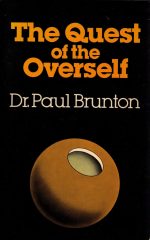
Paul Brunton: The Secret Path

A Technique of Spiritual Self-Discovery for the Modern World

Rider, 1934

Book Description (from one of the later Rider editions):

Brunton“The treasure-trove of the real self is within us, but it can be lifted only when the mind is still.”

Paul Brunton was one of the 20th century’s greatest explorers of, and writers on, the spiritual traditions of the East. He travelled widely throughout India (in particular) and met gurus and teachers who enriched his life immeasurably. By passing on to us the wisdom he learned directly from these holy men, he is widely credited as having introduced yoga and meditation to the West.

In The Secret Path, Paul Brunton explains in simple language how to meditate, and how this will transform your everyday existence. He also describes the remarkable experiences and understandings he himself gained from meditation and how, by making this ancient practice a part of your life, you will be able to experience a valuable kind of freedom and a deep inner peace.

The classic work – which has been reprinted many times – is a very special pointer towards your inner world, and one written by a most unusual and adventurous man of insight.

Praise for Paul Brunton (from the same edition):

“Paul Brunton was surely one of the finest mystical flowers to grow on the wasteland of our secular civilization. What he has to say is important to us all.”  George Feuerstein

“…a great gift to us Westerners who are seeking the spiritual.”  Charles T. Tart

“A person of rare intelligence…thoroughly alive, and whole in the most significant, ‘holy’ sense of the word.”  Yoga Journal

“Paul Brunton was a great original and got to a place of personal evolution that illumines the pathways of  a future humanity.”  Jean Houston

“A simple, straightforward guide to how philosophical insights of the East and West can help create beauty, joy, and meaning in our lives…His keynote is balance, and his uplifting message encompasses all phases of human experience.”  East West Journal

“…sensible and compelling. His work can stand beside that of such East-West bridges as Merton, Huxley, Suzuki, Watts and Radhakrishnan. It should appeal to anyone concerned personally and academically with issues of spirituality.”  Choice

“Any serious man or woman in search of spiritual ideas will find a surprising challenge and an authentic source of inspiration and intellectual nourishment in the writings of Paul Brunton.”  Jacob Needleman

About the Author (from the same edition):

Born in London in 1898, Paul Brunton published thirteen books between 1935 [according to my edition of The Secret Path, the first edition was published in 1934 – JOB] and 1952. He is generally recognized as having introduced yoga and meditation to the West, and for presenting their philosophical background in non-technical language. He died in Switzerland (where he lived for 20 years) in 1981.
Contents:

I     With a Wise Man of the East

II    Man – Science’s Greatest Riddle!

III   The Mysterious Overself

IV    The Practice of Mental Quiet

V     A Technique of Self-Analysis

VI    A Breathing Exercise to Control Thoughts

VII   The Awakening to Intuition

VIII  The Awakening to the Overself

IX    The Way of Divine Beauty

X     The Gospel of Inspired Action

XI    Spiritual Help in Material Affairs

XII   The Epilogue

JOB’s Comment:

It is difficult to choose modern books on spirituality to recommend. No one expresses only my own views. But most of course contain some of them. Brunton’s were among the first I read, back in the 1970s. See also my earlier Brunton posts, in the Spirituality category.

Joscelyn Godwin: The Golden Thread

The Ageless Wisdom of the Western Mystery Traditions

Quest Books, 2007

Amazon.com

Publisher’s description:

The Golden Thread traces the interconnectedness of esoteric wisdom in the Western world, from classical antiquity to contemporary Europe and America. Joscelyn Godwin lends personal perspective to an arrangement of text that is historical and wisdom that is timeless, creating a source of inspiration that calls us to action in our everyday spiritual practice. Every chapter, therefore, makes reference to some aspect of contemporary life and issues of immediate concern. Elegantly written and not without irony and humor, readers will appreciate the non-threatening tone of Godwin’s writing, which is not meant to preach or convert but rather inform the public on an often baffling field. Educated readers who are curious about the esoteric and mystery traditions and interested in finding surprising, new approaches to subjects that veer away from the trends of current thought will be particularly drawn to this book.

Back cover:

Godwin is a modern psychopomp, leading us into the secret chambers of the ancient world.

Gary Lachman, author of In Search of P. D. Ouspensky

The ancient sages of the Western Mystery Traditions passed on a knowledge beyond reason, allowing us to access transcendent states that reveal our own nature and that of the cosmos. Such sages exist in every age and elevate all of humanity, says Joscelyn Godwin, whether we realize it or not. Among those whose wisdom he traces from antiquity to the present include [sic]:

– Hermes Trismegistus

– Zoroaster

– Orpheus

– Pythagoras

– Plato

– the Gnostics, the alchemists

– and the Rosicrucians, Freemasons, and Theosophists

Each stage is always with us, Godwin emphasizes, and so each offers a potential source of inspiration and action for today.

“Joscelyn Godwin’s clear voice guides and expands our understanding in unexpected and rewarding ways, illuminating fascinating and little explored areas of the perennial philosophy.”

John Major Jenkins, author of Unlocking the Secrets of 2012

“Thoughtful and thought provoking, this is a delightful and erudite collectio of gently subversive essays – a book to savor.”

Arthur Versluis, author of Magic and Mysticism

Joscelyn Godwin, Ph.D., a widely respected authority of Western esotericism, is professor of music at Colgate University and author of The Theosophical Enlightenment. His translation of the Renaissance allegory Hypnerotomachia Poliphili was featured in the best-selling mystery, The Rule of Four.