Anders Björnsson & Sven Hirdman (red.): Bevara alliansfriheten – Nej till Nato-medlemskap!

Celanders förlag, 2014

Björnsson HirdmanUtan att Sverige är militärt hotat från något håll har det uppstått en yvig debatt om Sveriges ställning som alliansfritt land. Steg för steg har politiska beslutsfattare och militärer ökat samverkan med den västliga militäralliansen Nato – utan att det finns några militära hot mot Sverige och utan att varje steg prövats mot bakgrund av Sveriges traditionella ställning som neutralt och fredssinnat.
Man har till och med talat om en smyg­anslutning till Nato – att de styrande har velat etablera så många ”fakta på marken” att ett beslut om att söka svenskt Nato-medlemskap bara skulle vara en form­alitet. Men så långt har det inte gått. Folkopinionen är entydigt mot Nato-anslutning – i Sverige, liksom för övrigt i Finland. Det svenska folket vill som tidigare att landet ska hållas utanför krigiska förvecklingar.

Att det fortsatt finns mycket goda skäl för en sådan hållning belyses genom en rad analyserande – och delvis också agiterande – artiklar i denna motskrift till en pågående ”Nato-offensiv” från politiker, militärer och opinionsbildare.

Författarna:

Anders Björnsson och Sven Hirdman har varit redaktörer, förordet har författas av Thage G Peterson och för texterna svarar Mats Bergquist, Carl Björeman, Anders Björnsson, Hans Blix, Hans Corell, Rolf Ekéus, Anders Ferm, Sven Hirdman, Katrine Marçal, Leif Pagrotsky, Pierre Schori, Sören Sommelius, Maj Britt Theorin, Erkki Tuomioja och Lennart Uller.

Harry Redner: Beyond Civilization

Society, Culture, and the Individual in the Age of Globalization

Transaction, 2013

RednerDescription:

For Harry Redner, the phrase “beyond civilization” refers to the new and unprecedented condition the world is now entering – specifically, the condition commonly known as globalization. Redner approaches globalization from the perspective of history and seeks to interpret it in relation to previous key stages of human development. His account begins with the Axial Age (700–300 BC) and proceeds through Modernity (after AD 1500) to the present global condition.

What is globalization doing to civilization? In answering this question, Redner studies the role played by capitalism, the state, science and technology. He aims to show that they have had a catalytic impact on civilization through their reductive effect on society, culture, and individualism.

However, Redner is not content to diagnose the ills of civilization; he also suggests how they might be ameliorated by cultural conservation. Above all, it is to the problem of decline in the higher forms of literacy that he addresses himself, for it is on the culture of the book that previous civilizations were founded. This study will be of interest to sociologists, historians, and social and political theorists. Its style makes it accessible also to general readers, interested in civilization past, present, and future.

Reviews:

“Redner (Monash Univ., Australia) examines how the processes unleashed by globalization are usurping civilization as a means of social organization and mode for arranging identity. He argues that as globalization begins to make the World ‘unified’ and ‘uniform’, it wears away the cultural distinctions that have defined different forms of civilization. As this occurs, the historical foundations of cultural life found in the traditions of world civilizations become threatened with extinction as the civilizations evolve into an undifferentiated, globalized mass culture. Redner’s focus is primarily on the rise of Western civilization, particularly since the advent of modernity. Western modernity essentially unleashes a series of social processes that spread globally, such as industrial capitalism, the legal-rational state, and a focus on science and technology. In the wake of this dispersion of modernity, people are left in a ‘post-civilization’ age composed of a culture without depth and a cosmopolitanism without substance… [F]or those interested in a broad overview of the effects of modernity and globalization, the book is indispensable… Highly recommended.”  S. C. Ward, Choice

“[E]xplores the replacement of unique worldwide civilizations with one unified global culture.”  Book News

Beyond Civilization challenges us to rethink contemporary world society in the light of the great historical civilizations of East and West and their progressive dissolution and destruction by the combined forces of modernity from capitalism and the state to science and technology. The author opens up productive new perspectives by bringing globalization and civilizational theory together in a mutually illuminating interrogation, which informs and frames the crucial question of the future of civilization in the age of technological globalization.”  David Roberts, author, The Total Work of Art in European Modernism

“Will the protean dynamism of modernity finally gobble up culture or civilization? Harry Redner has been stretching our brains over these issues for forty years. Magisterial in scope, critical but generous in inflection, his new book is breathtaking. It takes a life’s work to achieve this: here is the book that is its result.”  Peter Beilharz, La Trobe University, Australia

About the Author:

Harry Redner was reader at Monash University in Melbourne, Australia and was visiting professor at Yale University, University of California-Berkeley, and Harvard University. He is also author of Totalitarianism, Globalization, Colonialism and many other books.

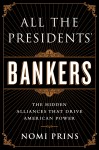
Nomi Prins: All the Presidents’ Bankers

The Hidden Alliances that Drive American Power

Nation Books, 2014

Summary:

PrinsWho rules America?

All the Presidents’ Bankers is a groundbreaking narrative of how an elite group of men transformed the American economy and government, dictated foreign and domestic policy, and shaped world history.

Culled from original presidential archival documents, All the Presidents’ Bankers delivers an explosive account of the hundred-year interdependence between the White House and Wall Street that transcends a simple analysis of money driving politics – or greed driving bankers.

Prins ushers us into the intimate world of exclusive clubs, vacation spots, and Ivy League universities that binds presidents and financiers. She unravels the multi-generational blood, intermarriage, and protégé relationships that have confined national influence to a privileged cluster of people. These families and individuals recycle their power through elected office and private channels in Washington, DC.

All the Presidents’ Bankers sheds new light on pivotal historic events – such as why, after the Panic of 1907, America’s dominant bankers convened to fashion the Federal Reserve System; how J. P. Morgan’s ambitions motivated President Wilson during World War I; how Chase and National City Bank chairmen worked secretly with President Roosevelt to rescue capitalism during the Great Depression while J.P. Morgan Jr. invited Roosevelt’s son yachting; and how American financiers collaborated with President Truman to construct the World Bank and IMF after World War II.

Prins divulges how, through the Cold War and Vietnam era, presidents and bankers pushed America’s superpower status and expansion abroad, while promoting broadly democratic values and social welfare at home. But from the 1970s, Wall Street’s rush to secure Middle East oil profits altered the nature of political-financial alliances. Bankers’ profit motive trumped heritage and allegiance to public service, while presidents lost control over the economy – as was dramatically evident in the financial crisis of 2008.

This unprecedented history of American power illuminates how the same financiers retained their authoritative position through history, swaying presidents regardless of party affiliation. All the Presidents’ Bankers explores the alarming global repercussions of a system lacking barriers between public office and private power. Prins leaves us with an ominous choice: either we break the alliances of the power elite, or they will break us.

Reviews:

All the Presidents’ Bankers spins an enormous amount of research into a coherent, readable narrative. Even her frequent kvetches about the lifestyles of rich and famous bankers are entertaining…There is always room for criticism, and Ms. Prins does it rather well. Banking was her first career before taking up journalism. She can talk the talk and is knowledgeable about the many points where banking and public policy intersect…Give her credit…for seeing through the façade of Dodd-Frank into the danger of another meltdown that lurks in our day of quasi-nationalized banking.”  George Melloan, Wall Street Journal

“A calm, authoritative elucidation of verifiable history”  Financial Times

“Even those who have read Secrets of the Temple, William Greider’s massive and brilliant 1987 exposé of the Federal Reserve, will find Prins’s book worth their time. She presents a new narrative, one that shows how the changing cast of six has shaped America’s fortunes under presidents in both parties.”  American Prospect

“Prins divides her justifiably long text into digestible one- to three-page segments and seamlessly incorporates dozens of prominent banker profiles. Her work is highly recommended both to general readers and to students of financial history.”  Library Journal

“A revealing look at the often symbiotic, sometimes-adversarial relationship between the White House and Wall Street… [A] sweeping history of bank presidents and their relationships with the nation’s chief executives.”  Kirkus Reviews

“This book offers a time line analysis of Americans who granted or wielded tremendous power in unelected positions of public trust, on behalf of US presidents and cabinet secretaries, from the 1880s through 2013… [Prins] tackles hundreds of handwritten letters, archives, and documents necessary to research her subject; her findings provide insight into how US policy advisers juggled their allegiances between their employers, clients, and contacts in the White House, and the good of the nation.”  Choice

“The relationship between Washington and Wall Street isn’t really a revolving door. Its a merry-go-round. And, as Prins shows, the merriest of all are the bankers and financiers that get rich off the relationship, using their public offices and access to build private wealth and power. Disturbing and important.”  Robert B. Reich, Chancellor’s Professor of Public Policy, University of California at Berkeley

“Nomi Prins follows the money. She used to work on Wall Street. And now she has written a seminal history of America’s bankers and their symbiotic relationship with all the presidents from Teddy Roosevelt through Barack Obama. It is an astonishing tale. All the Presidents’ Bankers relies on the presidential archives to reveal how power works in this American democracy. Prins writes in the tradition of C. Wright Mills, Richard Rovere and William Greider. Her book is a stunning contribution to the history of the American Establishment.”  Kai Bird, Pulitzer Prize-winning biographer and author of The Good Spy: The Life and Death of Robert Ames

“Nomi Prins takes us on a brisk, panoramic, and eye-opening tour of more than a century’s interplay between America’s government and its major banks – exposing the remarkable dominance of six major banks, and for most of the period, the same families, over U.S. financial policy.”  Charles R. Morris, author of The Trillion Dollar Meltdown

“Nomi Prins has written a big book you just wish was bigger: page after page of killer stories of bank robbers who’ve owned the banks – and owned the White House. Prins is a born story-teller. She turns the history of the moneyed class into a breathless, page-turning romance – the tawdry affairs of bankers and the presidents who love them. It’s brilliant inside stuff on unforgettable, and unforgivable, scoundrels.”  Greg Palast, Investigative reporter for BBC Television and author of Billionaires & Ballot Bandits

“In this riveting, definitive history, Nomi Prins reveals how US policy has been largely dominated by a circle of the same banking and political dynasties. For more than a century, Presidents often acquiesced or participated as bankers subverted democracy, neglected the public interest, and stole power from the American people.”  Paul Craig Roberts, former Wall Street Journal editor and Assistant Secretary of the US Treasury

“Nomi Prins has done it again – this time with a must read, a gripping, historical story on the first corporate staters – the handful of powerful bankers and their decisive influence over the White House and the Treasury Department from the inside and from the outside to the detriment of the people. All the Presidents’ Bankers speaks to the raw truth today of what Louis D. Brandeis said a hundred years ago: ‘We must break the Money Trust or the Money Trust will break us.’”  Ralph Nader

“Money has been the common denominator in American politics for the last 115 years, as Nomi Prins admirably points out. All the Presidents’ Bankers is an excellent survey of how money influences power and comes dangerously close to threatening democracy.”  Charles Geisst, author of Wall Street: A History

“All the Presidents’ Bankers is gracefully written, carefully researched, and accessible. It is a must read for anyone concerned with politics and economics – in other words, just about everybody.”  Thomas Ferguson, Professor of Political Science at the University of Massachusetts, Boston and Senior Fellow at the Roosevelt Institute

About Nomi Prins:

Nomi Prins is a journalist, speaker, respected TV and radio commentator, and former Wall Street executive. Author of five other books, including Other People’s Money and It Takes a Pillage, her writing has been featured in the New York Times, Fortune, Mother Jones, the Guardian, the Nation, and other publications. She is a senior fellow at Demos. Follow her on Twitter @NomiPrins

Adam LeBor: Tower of Basel

The Shadowy History of the Secret Bank that Runs the World

Public Affairs, 2014 (2013)

Summary:

LeBorTower of Basel is the first investigative history of the world’s most secretive global financial institution. Based on extensive archival research in Switzerland, Britain, and the United States, and in-depth interviews with key decision-makers – including Paul Volcker, the former chairman of the US Federal Reserve; Sir Mervyn King, governor of the Bank of England; and former senior Bank for International Settlements managers and officials – Tower of Basel tells the inside story of the Bank for International Settlements (BIS): the central bankers’ own bank.
Created by the governors of the Bank of England and the Reichsbank in 1930, and protected by an international treaty, the BIS and its assets are legally beyond the reach of any government or jurisdiction. The bank is untouchable. Swiss authorities have no jurisdiction over the bank or its premises. The BIS has just 140 customers but made tax-free profits of $1.17 billion in 2011-2012.

Since its creation, the bank has been at the heart of global events but has often gone unnoticed. Under Thomas McKittrick, the bank’s American president from 1940–1946, the BIS was open for business throughout the Second World War. The BIS accepted looted Nazi gold, conducted foreign exchange deals for the Reichsbank, and was used by both the Allies and the Axis powers as a secret contact point to keep the channels of international finance open.

After 1945 the BIS – still behind the scenes – for decades provided the necessary technical and administrative support for the trans-European currency project, from the first attempts to harmonize exchange rates in the late 1940s to the launch of the Euro in 2002. It now stands at the center of efforts to build a new global financial and regulatory architecture, once again proving that it has the power to shape the financial rules of our world. Yet despite its pivotal role in the financial and political history of the last century and during the economic current crisis, the BIS has remained largely unknown – until now.

Reviews:

“Despite a title that makes it sound like conspiracy-theory nonsense, this is a serious, well-documented story about a very real bank, the Bank for International Settlement (BIS), which predates both the International Monetary Fund and the World Bank. Founded by the governors of the national banks of Britain, France, Italy, and the U.S. in 1930, the bank was created to oversee German reparations payments after WWI. Drawing on previously published sources, original research, and interviews with some of the key players in the story, the author introduces readers to this little-known but highly influential bank and charts its course into the twenty-first century. It’s a story of financial intrigue, secrets and lies, rumor and truth. LeBor, a business journalist (he’s also the author of several thrillers), knows how to make a true story about finance as thrilling as any spy novel. A highly entertaining and informative book about the most powerful bank you’ve probably never heard of.”  David Pitt, Booklist
“Adam LeBor’s Tower of Basel: The Shadowy History of the Secret Bank That Runs the World makes a strident case for challenging these financial shamans [central bankers]…Mr. LeBor’s polemical tone makes his book compelling…It’s a very ugly picture, and Mr. LeBor has painted it well.”  Wall Street Journal

Tower of Basel is essential reading. Meticulously researched and fluently written, it reveals a slice of the modern world’s untold history – a gripping tale of covert networks, secret deals and unaccountable, powerful individuals whose decisions shape our lives.”  Edward Lucas, author of Deception: The Untold Story of East-West Espionage Today

“Adam LeBor has written an absolutely fascinating history of the BIS, perhaps the most enigmatic financial institution in the world. The story he unveils of the many skeletons in its closet and its astounding ability to remake itself periodically only add to its mystique.”  Liaquat Ahmed, author of Lords of Finance: The Bankers Who Broke the World

“Compelling reading – a masterly depiction of the role of the BIS in the Nazi period and Second World War.”  Harold James, professor of history and international affairs, Princeton University, and author of Making the European Monetary Union

“An absorbing and thorough examination of one of the world’s most important yet opaque institutions”  Reuters Breaking Views

“[LeBor] does a creditable job in this well-researched account.”  New York Times Book Review

“LeBor exposes the wheeling, dealing, and often nefarious activities of global investment bankers…Lively…The historical and contemporary power of the secretive BIS will surprise and alarm readers.”  Publishers Weekly

 About Adam LeBor:
Adam LeBor is an author, journalist, and literary critic based in Budapest. He writes for The Economist, The Times (London), Monocle, and numerous other publications, and also reviews books for the New York Times. He has been a foreign correspondent since 1991, covering the collapse of communism and the Yugoslav wars, and has worked in more than thirty countries. He is the author of seven critically acclaimed nonfiction books, including the ground-breaking Hitler’s Secret Bankers, and two novels. His books have been published in twelve languages.

Den Boströmska världsåskådningen: Om Gud och själens odödlighet, 3

Av Lawrence Heap Åberg

JOBs inledning     Inledning     Filosofins begrepp     Fenomenologi, 1

Fenomenologi, 2     Läran om människan, 1     Läran om människan, 2

Om Gud och själens odödlighet, 1     Om Gud och själens odödlighet, 2

Men en ändlig personlighet, sådan som människan, hur skall den förklaras? Vad är den egentligen? Såsom ändlig tarvar den en förklaring, men ur det omedvetna och opersonliga kan det medvetna och personliga ej förklaras, enär det förra är till endast för det senares ofullkomliga uppfattning, följaktligen genom detta. Den ofullkomliga personligheten kan endast förklaras ur den fullkomliga.

Den ändliga personligheten är, säger Boström, till sitt innersta väsende en fullkomlig förnimmelse hos Gud eller en hans eviga idé. Låt oss se, vad detta egentligen betyder.

Guds förnimmelser är naturligtvis absolut fullkomliga. Det mänskliga uppfattningssättet, som vi kallar känsla, innebär, som vi erinrar oss, dunkel och otydlighet i förnimmandet, följaktligen också ofullkomlighet. Allt sådant måste vi frånkänna Gud. Han har inga känslor, endast klara och tydliga förnimmelser eller tankar. Mången torde rysa tillbaka för en sådan lära – Gud blir ju på detta sätt en död Gud – åtminstone tyckes hans förnimmande förlora sig i tomma abstraktioner. Så skulle det visserligen förhålla sig, i fall den ofullkomlighet, som vidlåder vårt ändliga mänskliga tänkande finge överflyttas på Gud. Men vi har ingen rätt att så göra. Vår mänskliga tanke mäktar ej fatta tingen i det hela, utan blott vissa sidor hos dessa. Vi förstår ej tingen, utan deras egenskaper, vi tänker ej tingen, utan vi tänker över dem, och häri visar sig, att vårt förstånd är i viss mån innehållsfattigt. Vad som häri brister oss, måste kompletteras av vår känsla, som är oändligt innehållsrik. Vad vi klart fattar, det fattar vi ofullständigt, vad vi fattar fullständigt, fattar vi dunkelt. Det är nu visserligen sant, att Guds förnimmande måste äga den innehållsrikedom, som tillkommer vår känsla, men denna rikedom köpes ej här på klarhetens bekostnad. Gud förstår ej, såsom vi, sidor i verkligheten, utan han förstår hela verkligheten, ty hans klara och tydliga förnimmande äger den innehållsrikedom, som hos oss endast kan tillkomma den dunkla förnimmelsen, känslan. Det är följaktligen, emedan man fattat det gudomliga tänkandet i analogi med det mänskliga, som man erfarit behovet av att tillägga Gud känslor. Man har därvid förgätit, att när man på Gud överflyttar mänskliga egenskaper, så måste man se till att man renar dessa från all ofullkomlighet (i detta fall dunkel) och blott fasthåller deras fullkomliga sida (i detta fall innehållsrikedom).

Men vad är det då som Gud tänker? Icke det döda och opersonliga, utan det levande och personliga. Varje Guds tanke är i och för sig betraktad ett livande och medvetet väsende, en personlighet. Att så måste vara fallet framgår därav, att Guds tankar måste äga sanning och verklighet. Ty endast det medvetna och personliga äger verklighet i sann mening.

Varje Guds tanke är såsom sådan idel fullkomlighet, ty i och för Gud är intet annat än det, som fullkomligt är. Men är de personliga väsenden, som utgör innehållet i Guds tankevärld, därför även fullkomliga, då de tänkas såsom personer? Nej, förvisso icke. Det kan icke förhålla sig så. De skulle ju då sammanfalla med Gud. Men det gör det icke. De har sitt liv och sin tillvaro icke i och genom sig själva, utan i och genom Gud. Därför är de också som personer eller förnimmelsesubjekt betraktade ofullkomliga. De är av Gud fullkomligt förnumna, men själva ofullkomligt förnimmande. De förnimmer visserligen den ena och sanna verkligheten. Gud och hans eviga tankar, men de förnimmer den på ett ofullkomligt sätt. Den framstår för dem såsom en mer eller mindre ofullkomlig fenomenvärld, ett helt av ofullkomliga förnimmelser.

Ett slag av sådana ofullkomliga väsenden är nu människan. Och den för henne, d. v. s. den i sina grunddrag för alla människor gemensamma fenomenvärlden är den oss omgivande världen i rum och tid – vad vi kallar naturen.

På detta sätt skall nu enligt Boström natur och människoande förklaras ur Gud eller tänkas i honom ha sin eviga grund, den senare omedelbart, den förra endast medelbarligen, men båda av evighet och på ett nödvändigt sätt. Då vi bekänner: ”Jag tror på Gud Fader allsmäktig, himmelens och jordens skapare”, så utsäger vi därmed, att natur och människoliv ej har sin grund i sig själva, utan i en absolut personlighet. Men har man än blicken öppen härför, och följaktligen antar ett slags världsskapelse, så förefinnes dock en möjlighet att fatta själva denna världsskapelse såsom ett slags naturprocess eller något därmed jämförligt. Vanligen sker detta så, att den fattas i något slags analogi med en naturutveckling, följaktligen något varigenom Gud skulle vinna en högre grad av fullkomlighet. Gud vore då liksom ett frö, ur vilket världen utvecklas. Detta panteistiska antagande kan ej vara förenligt med den Boströmska världsåskådningen. Nej, alla naturanalogier, all tanke på fullkomnande måste hållas fjärran från det absoluta väsendet. Av evighet och alldeles oberoende av ändlighetens värld är han, den evige, för vilken ingen tid, ingen växling finnes, absolut fullkomlig, och av honom framgår endast det som fullkomligt är.

Allt detta ligger i den tanken, att man för världens förklaring måste gå tillbaka till en i sig själv fullkomlig och personlig världsskapare. Frågan är nu blott hur världsskapelsen är att fatta. Vi har redan anmärkt, att den ej får fattas som en godtycklig akt i tiden. Allt vad Gud är, det är han med nödvändighet och av evighet. ”Hos honom är ingen förändring eller växling av ljus och mörker.” Är han därför världsskapare, så är han det också av evighet. Vill vi kläda detta i ett språk, som närmare påminner om kristendomens uttryckssätt i denna punkt, så skulle detta ske så att om Gud skapade världen för sin oändliga kärleks skull, så var det ej en tillfällighet att han så gjorde. Liksom han av evighet haft världen närvarande i sina tankar, så har han också av evighet älskat den. För honom har världen sålunda aldrig uppkommit. Blott för sig själv och för andra ändliga väsen kan en ändlig varelse liksom ändligheten över huvud sägas börja att vara till. För Gud har den av evighet varit.

Som man ser, opponerar sig Boström i och med detta ej blott mot den äldre supranaturalistiska skapelseläran, sådan vi stundom påträffar den i sextonhundratalets teologi, utan jämväl även mot den moderna deismens läror i denna punkt. Båda dessa åsikter antar en mer eller mindre godtycklig världsskapelse i tiden, men under det att den förra menar att Gud även sedermera understundom ingriper i världshändelsernas gång, så berömmer sig den senares anhängare av att kunna undvara dylika extraordinära tilldragelser. Gud, menar de, har nog mäktat skapa en så förträfflig värld, att den kan sköta sig själv. Onekligen måste man ge de senare rätt såtillvida, att dylika extraordinära ingrepp, i form av godtyckliga rubbningar i världshändelsernas gång, måste anses oförenliga med ett tillfredsställande begrepp om Gud, men detta av alldeles samma skäl som de, vilka gör en världsskapelse i tiden till en omöjlighet. Å andra sidan erfar deismens ovannämnda motståndare livligare behovet av att fasthålla ett intimt samband mellan Gud och ändligheten. Som man finner, utgår båda från förutsättningen av en godtycklig världsskapelse i tiden. Avlägsnas denna förutsättning, så ställer sig saken ej så litet annorlunda. Detta för oss emellertid över till en annan fråga, frågan om Guds försyn.

Det är givet att den som ej betraktar världsskapelsen som en en gång i tiden timad tilldragelse, utan anser att den ingenting annat innebär än att världen har sin grund i en av densamma helt och hållet oberoende personlig Gud, för honom måste Guds närvaro på varje punkt av världsutvecklingen vara lika omedelbar. Och den, som ej sätter Gud i något yttre förhållande till världen, för honom är också Gud i allra fullaste bemärkelse närvarande i allt. Denna hans närvaro röjer sig ej i tillfälliga, världsordningen störande rubbningar, utan just i världens lagbundenhet och ordning. Denna lagbundenhet och denna ordning är nämligen, såsom fästade vid det opersonliga, sådana att de ej kan förklaras ur sig själva eller ur världen, utan blott ur en personlig världsordnare. Men eftersom vår ande har sin grund i Gud, så har även dessa lagar, följaktligen också varje i enlighet med dem timad tilldragelse, sin yttersta grund i honom. Så, men ej genom antagandet av tidtals skeende underverk, blir världsstyrelsen fullständig, så blir det också en sanning, att ”en sparv ej faller till marken vår himmelske Faders vilja förutan”.

Men denna Guds världsregering måste syfta till något ändamål. Vi har anmärkt att man ej kan förneka, att naturen verkar ändamålsenligt, ehuru man ej kan i henne själv finna hennes högsta ändamål. Då de gamle tänkte sig ett opersonligt öde såsom alltings styresman, så innebar detta i själva verket samma uppfattning, som den, vilken nu framträder hos dem som söker grunden till naturens lagbundenhet i naturen själv och tror sig inom den finna det mål, vartill allt syftar, så framt de ej förnekar ett att sådant mål finnes. Att det senare i själva verket, om man tänker ut vad däri ligger, innebär förnekande jämväl av naturens lagbundenhet, torde lätt inses. Ty frågar man varför naturens lagar är just sådana de är, så finner man härpå platt intet svar och hänvisas följaktligen ytterst till en tillfällighet, på vilken allt skulle bero, och förhåller det sig så, så har man i sanning inga garantier för att ju icke en annan tillfällighet kan laga att det i morgon blir annorlunda. Vi har också anmärkt, att varje försök att förlägga naturens högsta mål inom naturen själv leder till att förneka dess ändamålsenlighet.

Allt detta utgår emellertid från den förutsättningen att ingen högre och sannare verklighet finns än naturen. Häremot står en annan åsikt, den som hänför naturens lagbundenhet till en absolut personlighet, en allvis försyn, som leder allt till ett personligt ändamål. Vi har redan angivit en av de betydelser, i vilka detta icke får fattas. Men, invänder någon, Gud är då i alla fall verksam; strider ej detta mot hans evighet och oföränderlighet? Förvisso är Gud verksam, men icke i den bemärkelsen att världsutvecklingen, som åtskilliga panteister förmenar, skulle vara en hans självutveckling till högre fullkomlighet. Han är det endast i den bemärkelsen, att det är genom honom och förmedelst honom som världsutvecklingen fortgår så som den fortgår. Det är då tydligen alldeles detsamma, om han säges vara verksam i och för ändligheten eller om man säger att det är ändligheten som är verksam, ehuru på ett sätt, som blott genom honom blir förklarligt och begripligt.