De synpunkter på fallet Assange som idag framförs av Helene Bergman och Anders Carlgren i DN och tidigare i veckan av Paul Craig Roberts (på svenska på Fria Tider) måste beaktas, oavsett vad man anser om Assanges WikiLeaks-verksamhet. Hinner inte kommentera detta närmare nu men återkommer eventuellt här senare.
Category: Politics
Daniel Estulin: The True Story of the Bilderberg Group
Trine Day, 2009 (2007) Amazon.com
Book Description:
 Delving into a world once shrouded in complete mystery and impenetrable security, this investigative report provides a fascinating account of the annual meetings of the world’s most powerful people – the Bilderberg Group. Since its inception in 1954 at the Bilderberg Hotel in the small Dutch town of Oosterbeek, the Bilderberg Group has been comprised of European prime ministers, American presidents, and the wealthiest CEOs of the world, all coming together to discuss the economic and political future of humanity. The working press has never been allowed to attend, nor have statements ever been released on the attendees’ conclusions or discussions, which have ramifications on the citizens of the world. Using methods that resemble the spy tactics of the Cold War – and in several instances putting his own life on the line – the author did what no one else has managed to achieve: he learned what was being said behind the closed doors of the opulent hotels and has made it available to the public. This second edition includes an entirely new chapter and updated information on topics such as an earlier attempt to break up Canada and the portents of a North American union.
Reviews:
“If you want to know who really runs the world and the lengths to which they will go to establish their globalist hegemony, you must read Estulin’s well-documented The True Story of The Bilderberg Group.” carolynbaker.net
“Judging from the list of frontrunners of each party, Daniel Estulin…may be on to something.” WorldNetDaily
“For some 15 years, Estulin has been a thorn in the sides of the Bilderbergers, relentlessly hunting down their secret meeting places, gaining inside sources who divulge what goes on behind closed doors, even photographing attendees and publicly disclosing it all. Now he has put it all in a book that every person who values freedom and democracy should read.” Onlinejournal.com
About the Author:
Daniel Estulin is an award-winning investigative journalist and has been researching the Bilderberg Group for more than 14 years. He is the host of two radio shows in Spain.
Wolfgang Hetzer: Finanzmafia
Wieso Banker und Banditen ohne Strafe davonkommen
Kurzbeschreibung:
 Die Finanzkrise ist kein Ergebnis einer Naturkatastrophe, wie uns häufig vorgegaukelt wird. Außerdem unterstellt der Begriff “Krise” dass es sich um ein vorübergehendes Ereignis handelt, das durch Krisenmanagement beherrschbar ist. So wird davon abgelenkt, dass Organisationen, Institutionen, Einzelpersonen und Gruppen – als übliche Bankengeschäfte getarnt – hemmungslos ihre eigenen Interessen verfolgt haben. Mit krimineller Energie haben sie große Mengen Geld bewegt und in Netzwerken, die der Organisierten Kriminalität vergleichbar sind, dubiose Geschäfte getätigt. Doch die strafrechtliche Aufarbeitung des Geschehens hat bisher nicht stattgefunden. Wolfgang Hetzer fragt nach den Gründen und untersucht, welche Straftatbestände greifen könnten. Für ihn ist es höchste Zeit, dass das traditionell gegen die “Unterschicht” eingesetzte Strafrecht auch endlich gegen die “Oberschicht” angewendet wird.
Pressestimmen:
“Wolfgang Hetzer bekämpft für die EU Wirtschaftskriminalität: Nun zieht er gegen die ‘Finanzmafia’.” Kronen Zeitung
Hetzer zeigt in seinem Werk Finanzmafia gewohnt pointiert die Machenschaften von Hedgefonds-Managern, Bankern und der organisierten Finanz-Kriminalität auf.” Kurier
“Hetzer fordert…eine strafrechtliche Verfolgung der verantwortlichen Manager.” Die Presse
“Eine Pflichtlektüre im Superwahljahr 2011.” 3sat bookmark
“Dieses Buch hat Thriller-Qualität.” 3sat bookmark
“eine brillante Analyse” Süddeutsche Zeitung
“Der Autor zeigt die fließenden Übergänge zwischen professionellem und kriminellem Handeln in den Führungsetagen der Finanzindustrie.” Profil
“Hetzer widert die Ausrede vom Systemversagen an. Denn er erkennt ein Netz persönlicher Schuld: vom Broker über Bankvorstände, Investoren, Ratingagenturen bis hin zur Politik.” Deutschlandradio Kultur, Lesart
“Kaum einer kennt sich in der Organisierten Kriminalität so gut aus wie Wolfgang Hetzer. Und kaum ein anderer ist so tief in die Machenschaften von Finanzmanagern und Politikern vorgedrungen, die schließlich zur Finanzkrise und der europäischen Schuldenkrise führten. In seinem Buch Finanzmafia spricht er von einer ‘Leitkultur der Korruption’.” Welt online“Ein wortgewaltiges Buch” kontext:wochenzeitung“Hetzer beklagt eine unheilige Allianz zwischen Regierungen, Bankern und Wirtschaftsbossen, die mafiöse Ausmaße erreicht.” SWR Leute
Über den Autor:
Wolfgang Hetzer, promovierter Jurist, war bis 2012 als Abteilungsleiter im Europäischen Amt für Betrugsbekämpfung (OLAF) für die Aufklärung von Korruption zuständig. Zuvor war er im Bundeskanzleramt mit der Aufsicht über den BND betraut, unter anderem in den Bereichen organisierte Kriminalität und internationale Geldwäsche.
Jacques Ellul: Propagandes
Economica, 1990 (1962) Amazon.fr
Présentation de l’éditeur:
 Cet ouvrage, publié pour la première fois en 1962 a été l’un des tout premiers à mettre en évidence le caractère omniprésent et multiforme de la propagande. Dépassant les définitions classiques, il a montré que la propagande n’était pas l’apanage des dictatures, mais une nécessité pour tous les régimes, qu’elle ne se limitait pas à la guerre psychologique, mais englobait aussi les public and human relations destinées à adapter l’homme à une société. Près de trente ans après sa publication, ce livre demeure une référence indispensable pour la compréhension d’un phénomène qui n’a cessé de s’étendre et de se perfectionner.
Biographie de l’auteur:
Jacques Ellul n’a cessé d’approfondir sa réflexion sur la technique dans des livres devenus des classiques. Mais on ne peut comprendre son oeuvre sans se reporter à ce livre fondateur. Prophétiques lorsqu’elles ont été écrites, ses vues sur la technique comme fait central de nos sociétés conservent plus de 35 ans après une étonnante et parfois inquiétante actualité.
Barbara Walters’s Interview with Bashar al-Assad
Gore Vidal: Imperial America
Reflections on the United States of Amnesia
Nation Books, 2004 Amazon.com
Book Description:
 Following the publication of Perpetual War for Perpetual Peace and Dreaming War comes award-winning Gore Vidal’s long-awaited conclusion to his landmark, best-selling trilogy. Now, Vidal has written his most devastating exploration of Imperial America to date. “Not since the 1846 attack on Mexico in order to seize California,” Vidal writes, “has an American government been so nakedly predatory”. Bush’s apparent invincibility, and what he might or might not know – especially about those new “black box” voting machines being installed all over the country – is one of the central themes of “State of the Union 2004,” a magnificent and witty Olympian survey of American Empire, where the war on terror is judged as nonsensical as the “war on dandruff,” where America is an “Enron-Pentagon prison,” a land of ballooning budget deficits thanks to the growth of a garrison state, tax cuts for the privileged, and the creeping totalitarianism of the Ashcroft justice department. Collected in this volume are Vidal’s earlier State of the Union addresses, a tradition inaugurated on the David Susskind show in the early seventies as a counterpoint to “whoever happened to be president.”
Book Description (second edition):
Gore Vidal has been described as the last “noble defender” of the American republic. In Imperial America, Vidal steals the thunder of a right wing America – those who have camouflaged their extremist rhetoric in the Old Glory and the Red, White, and Blue – by demonstrating that those whose protest arbitrary and secret government, those who defend the bill of rights, those who seek to restrain America’s international power, are the true patriots. “Those Americans who refuse to plunge blindly into the maelstrom of European and Asiatic politics are not defeatist or neurotic,” he writes. “They are giving evidence of sanity, not cowardice, of adult thinking as distinguished from infantilism. They intend to preserve and defend the Republic. America is not to be Rome or Britain. It is to be America.”
Gore Vidal: Dreaming War
Blood for Oil and the Cheney-Bush Junta
Nation Books, 2002 Amazon.com
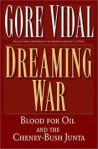 When Gore Vidal’s recent New York Times bestseller Perpetual War for Perpetual Peace was published, the Los Angeles Times described Vidal as the last defender of the American republic. In Dreaming War, Vidal continues this defense by confronting the Cheney-Bush junta head on in a series of devastating essays that demolish the lies American Empire lives by, unveiling a counter-history that traces the origins of America’s current imperial ambitions to the experience of World War Two and the post-war Truman doctrine. And now, with the Cheney-Bush leading us into permanent war, Vidal asks whose interests are served by this doctrine of pre-emptive war? Was Afghanistan turned to rubble to avenge the 3,000 slaughtered on September 11? Or was “the unlovely Osama chosen on aesthetic grounds to be the frightening logo for our long contemplated invasion and conquest of Afghanistan?” After all he was abruptly replaced with Saddam Hussein once the Taliban were overthrown. And while “evidence” is now being invented to connect Saddam with 9/11, the current administration are not helped by “stories in the U.S. press about the vast oil wealth of Iraq which must- for the sake of the free world – be reassigned to U.S. consortiums.”
–
“A pleasure for those convinced of the present ruling elite’s deep-seated flaws and deeper evils…tasty food for thought.” Kirkus Reviews
“Expect another bestseller.” Publishers Weekly
Gore Vidal, 1925-2012
2009

Bill Kauffman, ‘The Last Republican’ (2008 review of Selected Essays of Gore Vidal)
Brian Doherty, ‘Goodbye to Gore Vidal, America’s Biographer and Champion’
Edit, August 3:
Justin Raimondo, ‘Patriotic Gore’ (2004 review of Inventing a Nation: Washington, Adams, Jefferson)
Michael Lind, ‘Gore Vidal: The Virgil of American Populism’
Cf. my post ‘Till frågan om populismen‘ (in Swedish)
Gore Vidal: Perpetual War for Perpetual Peace
How We Got to Be So Hated
Nation Books, 2002 Amazon.com
Book Description:
 The United States has been engaged in what the great historian Charles A. Beard called “perpetual war for perpetual peace.” The Federation of American Scientists has cataloged nearly 200 military incursions since 1945 in which the United States has been the aggressor. In a series of penetrating and alarming essays, whose centerpiece is a commentary on the events of September 11, 2001 (deemed too controversial to publish in this country until now) Gore Vidal challenges the comforting consensus following September 11th and goes back and draws connections to Timothy McVeigh’s bombing of the federal building in Oklahoma City. He asks were these simply the acts of “evil-doers”?
“Gore Vidal is the master essayist of our age.” Washington Post
“Our greatest living man of letters.” Boston Globe
“Vidal’s imagination of American politics is so powerful as to compel awe.” Harold Bloom, The New York Review of Books
Reviews:
“Vidal writes with verve, passion and style that complements [his] controversial views.” Walter Russell Mead, Foreign Affairs, Sept/Oct 2002
“[Vidal] provides plenty of examples to sustain his shimmering abhorrence for current American politics…Challenging as ever.” Kirkus Reviews, March 15, 2002
John Kekes: Against Liberalism
Cornell University Press, 1997 Amazon.com
Blurbs:
 “John Kekes’s Against Liberalism offers compelling argumentation for the position that liberalism denies the very conditions it requires for its sustenance. As a consequence, liberal policies are inconsistent and self-defeating. Rarely has such a forthright and well-constructed argument been made against liberalism’s misguided flirtation with utopianism.” Herbert London
“This book deserves a place on the same shelf with Burke, Tocqueville, and Hayek. From now on no one counts as a serious conservative – even less, as a serious liberal – who has not paid it close attention.” Wallace Matson, University of California, Berkeley
“One of the many merits of John Kekes’s Against Liberalism is its careful argument that the priority attached to individual autonomy in recent liberal philosophies is unreasonable. In any sensibly pluralistic view, autonomy is only one among the necessary conditions…of human well-being. Others – such as peace, social cohesion and a healthy environment – are just as important. Further…these other components of the human good cannot always be made compatible with autonomy…Kekes’s central, unanswerable argument is that in unreasonably emphasizing the good of autonomy, recent liberalism evades the reality of such conflicts of values…Kekes’s imaginative and provocative book is only one of many unmistakable evidences of the passing of the Rawlsian regime in political philosophy. The ongoing dissolution of that liberal hegemony is a sign that pluralism is at last reaching into intellectual life. As a result, political philosophy may be able to reconnect with the world that it was once supposed to be about.” John Gray, Times Literary Supplement
“Kekes performs a useful task in identifying the contradictions in liberal political theory.” Kenneth R. Craycraft, Jr., The University Bookman
“A comprehensive, pointed and fair critique of the…assumptions that lie behind liberal policies, [Kekes’s book] demonstrates why the old liberal idea of giving people the moral autonomy to choose and live out good lives must, because of its self-contradictions, fail.” Robert Royal, Review of Metaphysics
“Incorporating his previous reflection about the relationship of character and morality, this work stands out in what is otherwise a well-populated chorus of questioners of liberalism.” John J. Barrett, Theological Studies
“Against Liberalism relentlessly questions and rejects…common assumptions of contemporary political philosophy…Unlike many of liberalism’s opponents, Kekes makes a serious effort to understand liberalism’s basic claims…A provocative and challenging book for students of political philosophy.” Samuel R. Freeman, Ethics
“Kekes’s book is very good; it is filled with arguments that are deep, complex and lively.” Shadia Drury, Toronto Globe and Mail
“Against Liberalism is a provocative and engaging book…What Kekes offers us is in fact amounts to a vivid external critique, on the basis of a less optimistic view of human nature. At its best, it is a powerful reminder that liberals had better take evil seriously too.” Norbert Awander, Zurich University, Ethical Theory and Moral Practice
About the Author:
John Kekes is Professor of Philosophy and Public Policy at the State University of New York at Albany.

