Boström’s Idealism
The first and most basic comment that needs to be made about Lawrence Heap Åberg’s Den Boströmska världsåskådningen (The Boströmian Worldview), or, through it, on Boström’s philosophy as such, concerns the nature of Boström’s idealism in general. In my first separate post with comments, Comments on Boström, I made very big, broad and sweeping claims for this idealism, suggesting, in fact, that it was superior, in general and with regard to its central positions, to all subsequent non-idealist currents of Western philosophy that have been dominant throughout the 20th century, and in some respects even to other versions of 19th-century idealism. This will certainly have seemed quite remarkable to most readers, and the first thing that has now to be added by way of further commentary is more support for those claims. But first of all, I want to say something more about my understanding of the role and meaning of idealism today.
The defence of idealism, including some of the forms of idealism that first developed in 19th-century Europe, has for me a broader significance than its metaphysical, ethical and other positions. It is part of a whole cultural dynamic, a natural development of the European spirit in the 19th century that, contrary to how it has been perceived by 20th-century historians of philosophy, in reality points ahead to the specific needs of the 20th century, including those of its cultural, social and political life. Broadly speaking, idealism represented a decisive advance in relation to the empiricist, lower rationalist, utilitarian and materialist legacy of the Enlightenment, which was also intrinsic to the liberal and capitalist social and political order (or disorder). Clearly distinct from the Marxist reaction to this order, as it remained tied to these obsolete philosophical currents even in its mobilization of its distorted reinterpretation of a selective Hegelianism, idealism in a broad sense was the 19th century’s own important alternative contribution, answering the questions raised and the problems caused by both of these historical forces, carrying forward and bringing to fruition the inner impulses, needs and exigencies of the development not only of philosophy but of culture in general at this point in the history of Europe.
Thus idealists not only in Germany but also in other European countries also characteristically offered, in outline, a social and political philosophy of their own, which sought to synthesize a historical legacy of values and insights that was in many respects threatened by the forces of radical modernism, with its own ways of meeting the undeniable social requirements of the new historical circumstances produced by modernity’s vast transformations. Boström himself, admittedly, did not yet perceive fully the necessity of developing this side of idealist thought, but some of his disciples and later followers, belonging to generations of European thinkers where these new issues were central to the social thought of idealism, understood the need to revise and develop further their positions in this regard – and, significantly, they found it possible to do so while preserving some of the distinct principles of Boström’s theory of the state.
Idealism, in its full and comprehensive meaning, thus constitutes the central, decisive advancement of the 19th century in relation to the Enlightenment and its lingering, typical philosophies, at its most developed a comprehensive cultural paradigm not only answering the needs of its day but pointing ahead to the situation of world-historical challenges that Europe would have to face in the 20th century. And since, as can be understood, for instance, from the list of philosophical schools which I provided, suggesting they were all inferior to and represented distinct forms of retrogression in relation to idealism, Europe did not, to put it mildly, successfully meet the challenges in the 20th century, it still stands before these challenges, now vastly aggravated. And hence the general idealist paradigm is in fact more relevant than ever.
Already in the title of his introduction to Boström or Boströmianism, Heap Åberg correctly emphasizes that what we are dealing with is a worldview, and thus the importance of the kind of comprehensiveness and coherence that a worldview implies. On a general level, the principles and the general orientation to which also specifically 19th-century expressions of idealism contributed, and which, as I briefly indicated, comprise distinctive social and political dimensions, remain not just relevant but, in a sense, necessary for the spiritual, cultural, moral and political defence and renewal of Europe. At the same time, it offers a far superior point of departure for authentic, historically based intercultural exchange with the rest of the world of the kind that is of course inevitable. Both through its philosophical penetration and its practical applications, it facilitates the search for, brings us closer to, the “common human ground”, the unity of universality and particularity in a multicultural world, that Claes Ryn speaks of, while at the same time representing the distinctly European manifestation of this synthesis that is needed for Europe’s own present purposes. It was always obvious that there is a natural limit to and an inevitable reaction against romantic, liberal-democratic and postmodern fragmentation, relativization, dispersion.
Idealism in the broad sense here indicated, in a general sense alone adequate to the challenges of modernity and even, in my view, in a sense inevitable for a European future, can of course, as a more general movement of cultural, social and political renewal, be assimilated in different aspects and on many levels for the various needs in all the fields of theory and practice. But for the purpose of its deeper understanding, the more difficult and exclusively philosophical issues of metaphysics, epistemology etc. must also be revisited and taught at least to a sufficient extent. In his Introduction to The Boströmian Worldview, Heap Åberg discusses the reasons why it is so much more difficult to explain the idealist position to the general reader than the widespread philosophical positions based on “common sense”. And he immediately proceeds to use a formulation that can be said to exemplify not only the difficulties in this regard with 19th century idealism more generally, but the specific difficulties with Boströmianism, with that aspect of it, or one of the aspects of it, which sets it apart from or goes beyond the dominant, originally German current of modern idealism.
This concerns the most basic, general position of Boström, reminiscent of and indeed developed with reference to Berkeley, but also bringing Boström closer than other forms of contemporary idealism to one aspect of Neoplatonism and, in substance, to aspects of Vedanta and some Buddhist schools in a way that clearly goes beyond Berkeley and his specifically modern empiricist concerns: what we experience as the external, material, corporeal world is in reality “a whole”, a totality, “of our own perceptions” (“ett helt av våra förnimmelser”). Formulations like this immediately produce a number of familiar misconceptions whose familiarity has never made them any less difficult to clear up or even reduce. They are almost always taken to mean that the phenomenal world is less real according to this kind of idealism than according to the common-sense view or philosophical materialism or physicalism, that it is a subjective experience only, perhaps just an illusion.
In reality the meaning of the position thus expressed is precisely the opposite. Although it does of course emphasize that this totality of perceptions, being our perceptions as finite beings, is limited, imperfect, relative etc., it also strongly emphasizes, in contradistinction precisely to common-sense realism, materialism, and physicalism, that within such general limitation caused by our own finitude, the world is really as we perceive it. The qualities of things, of the whole space-time world, are really there, are real and objective, not just secondary qualities incomprehensibly produced by our own sensual apparatus out of the inexplicable stimuli of merely primary-quality “matter”, unknowable in itself and somehow floating about out there (and in the course of the 20th century increasingly reduced to mere mathematical models). In a different sense, this idealist position could be said to be “realist”, whereas materialism turns out to be a bizarre speculative concoction of never ascertainable postulates. There is no “nothing but” about the world as a whole of our perceptions.
Now, I will not further elaborate this argument here. I have prepared these comments by posting in the References category a number of books by Bernardo Kastrup, in which can be found the most extensive and complete non-technical formulation, explanation and defense of this idealist position that I have ever seen. For the full comprehension of the most central and essential and at the same time most difficult and controversial idealist position in Boström’s system I therefore simply refer to Kastrup, and especially his book Why Materialism Is Baloney from 2014, but see also his other books under Philosophy on the References page; I have also posted a video where he gives a brief account of some aspects of his argument in this blog’s Idealism category.
Kastrup’s “popular” yet sophisticated statement of the argument is not only extensive, careful, and detailed, but also highly creative, innovative, and original. There is no reason for my purposes to add to it or even further comment on it here. This is the basic idealist position that people find to be the hardest to understand, the one that has always been the greatest challenge in all Boströmian idealist pedagogy. Once it has been understood – and I hope Kastrup will strongly and, for many, even decisively contribute to this – the most important task, the explanation of this most difficult yet decisive tenet of this form of idealism, will have been accomplished.
Further comment is needed only with regard to the positions where, within the general idealist framework thus established, Boström differs from Kastrup, namely in the distinctly “personalist” aspects of the former’s philosophy – a differentiation within idealism to which counterparts can also, as I have often emphasized, be found in the broader and older traditions referred to above. It could be argued that Kastrup’s articulation of this general idealist position as such implies precisely the distinctively “impersonalist” version or interpretation that Kastrup espouses, and that it does so to the extent that the position as formulated by him is not in reality a common position, shared by Boströmianism.
There are deep issues involved here having to do with the nature of the finitude of our perception of the world, and, as related to this, the nature of our existence as finite beings. But the fact that, at the present stage of the development of his thought at least, Kastrup differs in his conclusions regarding these things does not, in my view, invalidate or in any significant way minimize the relevance of the general argument from the “personal idealist” standpoint. I.e., the argument and the general idealist position it establishes are indeed, at least to a sufficient extent, common ones, they do provide a shared idealist framework within which, at a later point of more specific analysis, the differentiation of positions with regard to “finite centres” etc. emerges and can be contained. In this respect, the situation is similar to the relation – as discussed by me in The Worldview of Personalism and elsewhere – between what can for some purposes be called idealism in general, as affirmed also by forms of 19th-century impersonal absolutism, on the one hand, and at least some central versions of personal idealism.
Kastrup’s analysis of the world as a whole of perceptions can thus be affirmed even as his specific position regarding the nature of such centres and their relation to the absolute is bracketed, as it were, and identified as susceptible to certain modifications not unknown in the history of idealism – although clearly, for the purpose of relating them to Kastrup’s specific renewal of the idealistic argument and explaining them in terms of a modification precisely of his articulation, they stand in need in some respects of a correspondingly innovative reformulation. Needless to say, the resulting analytical and argumentative presentation would then also have to be related to and coordinated with the partly – certainly not entirely – different terminology of the earlier idealists.
If this position and its various implications are understood and accepted, it makes about as dramatic a difference as philosophical argument and theoretical insight can ever make. Given human nature, even that difference is not always sufficient to effect concrete changes in life and action, or even permanent insight. In most cases, it must be consolidated and supplemented by several other factors, having to do not least with the moral life, character, and faith, as also quite extensively discussed by Heap Åberg in Boströmian terms. Yet it can be concluded that, to the extent that such a thing is at all possible, the problematic legacy of the radical Enlightenment in philosophy that the idealists confronted (primarily in its 19th-century manifestations), with all of its moral, social and cultural ramifications, has been refuted.
The real consequences, once fully discovered, and by whichever supplementary means the discovery comes about, are vast, and often beautifully explained and illustrated by Kastrup in his other books, as affecting our lives and the way we live them. The implied necessary preconditions of the reality of the world being as explained by this idealistic analysis and argument of course involve several further positions, not least with regard to consciousness and spirituality. And these, in turn, are such as to make it easier to understand what I meant by my sweeping claims about this form of idealism in relation to twentieth-century philosophy. One important part of the metaphysics of idealism has in this way been established, in the sense and to the extent that things can be established in the specific Western institution of philosophy. There is more to the metaphysics of idealism than this. But without the core of insights reached and established in this and other ways, the further developments and applications of the idealistic worldview in the various fields of theory and practice cannot be correctly made, and the historic role of this worldview in the life of Europe and of European culture cannot be properly fulfilled.
Charles Bulfinch: Massachusetts State House, Boston

George A. Panichas & Claes G. Ryn, eds: Irving Babbitt in Our Time
CUA Press, 1986
Front Flap:
 Well before his death in 1933, Irving Babbitt had been internationally recognized as an American literary scholar and cultural thinker of unusual intellect, learning, and insight. Literature and life, he insisted, are indivisible. The study of literature must, in effect, become a discipline of ideas and imagination: a discipline that must distinguish between the significant and the insignificant, between literature with an ethical or moral center and literature subservient to the flux of relativism.
Babbitt’s admirers include Paul Elmer More, T. S. Eliot, Louis Mercier, Gordon Keith Chalmers, Walter Lippmann, and, in a later generation, Nathan Pusey, Walter Jackson Bate, and Peter Viereck. Among his critics are Edmund Wilson, Sinclair Lewis, H. L. Mencken, Ernest Hemingway, and Allen Tate. Although not always mentioned by name, Babbitt has remained a presence in American intellectual consciousness and literary criticism. Even his critics have been indelibly affected by his ideas.
Irving Babbitt in Our Time draws together the essays of ten recognized scholars for a reconsideration and critical reassessment of his work and to demonstrate Babbitt’s relevance to contemporary criticism.
Contents:
George A. Panichas & Claes G. Ryn: Introduction
Russell Kirk: The Enduring Influence of Irving Babbitt
George A. Panichas: Babbitt and Religion
Claes G. Ryn: Babbitt and the Problem of Reality
Folke Leander: Irving Babbitt and Benedetto Croce
Joseph Baldacchino: Babbitt and the Question of Ideology
Peter J. Stanlis: Babbitt, Burke and Rousseau: The Moral Nature of Man
T. John Jamieson: Babbitt and Maurras as Competing Influences on T. S. Eliot
Richard B. Hovey, Jr.: Babbitt and Contemporary Conservative Thought in America
Mary E. Slayton: Irving Babbitt: A Chronology of His Life and Major Works, 1865-1933
Charles de Foucauld

Phyllis Schlafly, Ed Martin & Brett M. Decker: The Conservative Case for Trump
Regnery, 2016. Go buy on Amazon.
From the Inside Flap:
 If you can’t stand Hillary Clinton, but wonder if you could vote for Donald Trump, you need to buy this book.
In it, you’ll learn from conservative icon Phyllis Schlafly – lawyer, bestselling author, and “sweet- heart of the Silent Majority” – why Donald Trump is worthy of every conservative’s vote.
Joined by Ed Martin, the former head of the Missouri Republican Party, and Brett Decker, formerly an editorial writer with the Wall Street Journal and the Washington Times, Schlafly presents the real Trump, the Trump she and her colleagues have met with and interviewed, the Trump who promises to be the most conservative president America has had since Ronald Reagan.
Like Reagan, Trump, if elected, will inherit an America on the ropes, an America transformed into an unhappy, unprosperous, weakened, and divided nation. He will face in Hillary Clinton a far left ideologue who considers herself above the law.
Trump is the antidote to all that – a first-time politician who could actually live up to his campaign slogan to “Make America Great Again.”
In The Conservative Case for Trump, Schlafly reveals:
1. How Trump’s appointees to the Supreme Court (on which Schlafly advised him) could be the most consequential in a century
2. How, unlike any other Republican, Trump could actually fix the nation’s immigration mess
3. Why his economic platform could spark an economic revival on the scale of the Reagan boom of the 1980s (it is based on much the same plan)
4. How Trump will defend the First Amendment – guaranteeing freedom of speech and religion – against an ever more dictatorial Left
5. Why Trump’s fresh thinking on defense and foreign policy is long overdue – and could send terrorism into rapid retreat
Donald Trump is the most controversial Republican presidential candidate since Barry Goldwater, and could be the most conservative and successful since Ronald Reagan. Phyllis Schlafly makes an irrefutable case that needs to be shared with every wavering voter. Nothing less than the future of our country is at stake. If you buy only one political book this year, it has to be The Conservative Case for Trump.
Reviews:
“Phyllis Schlafly is an American treasure who has been fighting the good fight for American sovereignty and cultural renewal for five decades. Without Phyllis, there’d be no Donald Trump. This book by Phyllis Schlafly, Ed Martin, and Brett Decker shows why Republicans not supporting Trump are helping elect Hillary Clinton.” Laura Ingraham, radio host and editor of LifeZette
“Donald Trump has dominated the election conversation in the 2016 cycle for a reason: he strikes a chord with voters who are sick of a political class that is running America into the ground. In The Conservative Case for Trump, Phyllis Schlafly, Ed Martin, and Brett M. Decker show how President Trump can get our country back on the right track, and why Republicans and independents need to unify behind his candidacy.” Newt Gingrich, former Speaker of the House of Representatives
“Phyllis Schlafly has been a brave, badly needed voice of resistance to the takeover of the Republican Party by business interests and bloodless ideologues who’d love to flood America with cheap immigrant workers (to do the jobs they haven’t already outsourced to other nations). Early on, she recognized the potential for Donald Trump to rebuild her party along more patriotic, common sense – and, she would say, Reaganesque – lines. What comes through in these pages by Schlafly, Martin, and Decker is the calm reason of veteran Republicans and patriots who can’t be bought or intimidated. I think a lot of Democratic patriots will be persuaded too.” Mickey Kaus, journalist and author
“The Conservative Case for Trump is nothing less than the case for saving America from socialist tyranny cemented into place with the votes of millions of Third-World immigrants. It is the case for making a U-turn to expand economic opportunity, an America First foreign policy, preserving our constitutional rights – especially our First and Second Amendment rights – and ending the insanity of government-enforced political correctness. Every conservative needs to read this book and heed the wisdom of the heroic Phyllis Schlafly.” Dr. Thomas DiLorenzo, professor of economics, Loyola University Maryland; senior faculty, Ludwig von Mises Institute; and author of The Problem with Socialism
About the Authors:
Phyllis Schlafly, the founder and CEO of Eagle Forum, has been a conservative icon since her bestselling book, A Choice Not an Echo, was published in 1964. A lawyer, activist, author, nationally syndicated columnist, and radio commentator, she lives in St. Louis, Missouri.
Ed Martin has been president of Eagle Forum since January 2015 and previously served as chairman of the Missouri Republican Party, a member of the Republican National Committee, and was chief of staff for Missouri governor Matt Blunt. He lives with his wife and four children in St. Louis.
Brett M. Decker has been an editor for the Wall Street Journal, editorial page editor for the Washington Times, and has written for publications ranging from the New York Times and USA Today to National Review and the American Spectator. He served in Republican leadership in Congress and was a senior appointee in the George W. Bush administration. Author of Bowing to Beijing and Global Filipino, he is from Detroit.
Jean-Jacques Olier
John Red Eagle & Vox Day: Cuckservative
How “Conservatives” Betrayed America
Castalia House, 2016. Go buy.

Book Description:
Fifty years ago, America was lied to and betrayed by its leaders.
With virtually no debate, Congress passed the most radical change to immigration law in American history. Since 1965, America has endured the biggest mass migration of people in human history, twice the size of the great wave of immigration into the USA between 1870 and 1930. As a result, Americans are being displaced in their own land by an ongoing invasion that dwarfs Operation Barbarossa, is two orders of magnitude larger than the Mongol hordes, and is one thousand times larger than the First Crusade.
America’s so-called conservative leaders and the conservative media have joined forces with liberal internationalists in openly celebrating this massive invasion, relying on bad theology, outdated economics, and historical myths to falsely claim that immigration is a moral imperative, an economic necessity, and in the national interest. Cuckservative: How “Conservatives” Betrayed America is a powerful defense of America’s right to exist as a nation by two Native American authors, as well as a damning indictment of a conservatism that has failed to conserve America’s culture and traditions.
This powerful and remorseless book addresses the myth of the Melting Pot, proves that mass immigration is a net negative for the U.S. economy, and exposes the anti-Christian ideology behind the Christian establishment’s support for multiculturalism and open borders. It even shows how 50 years of immigration have lowered America’s average IQ. The authors pull no punches in conclusively demonstrating that it is not right, it is not moral, it is not economically beneficial, and it is not Constitutional to betray America’s posterity.
In Cuckservative, John Red Eagle and Vox Day warn Americans that if they do not defend their culture, their posterity, and their nation, they will eventually find themselves on their own Trail of Tears.
About the Author:
Vox Day graduated in 1990 from Bucknell University with degrees in Economics and Asian Studies. He is a member of the Science Fiction and Fantasy Writers Association, the International Game Developers Association, and Mensa, and helped found the techno band Psykosonik. In addition to his weekly columns, he transmits contagious and controversial memes daily from the Vox Popoli blog.
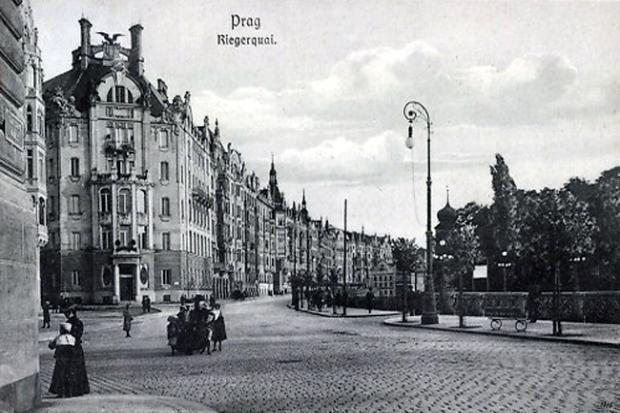
Riegerquai, Prag
Alternativhöger och post-paleokonservatism
Med Hillary Clintons uppmärksammade tal i veckan där Donald Trump associerades med “alt-right” har, som omedelbart konstaterades, denna rörelse blivit ett fenomen som alla kommentatorer nu känner till, sätter sig in i, och måste förhålla sig till: den har blivit en central faktor i amerikansk politik. Det finns därför anledning att försöka antyda något om just hur man bör förhålla sig. Kort kan sägas att det från mina utgångspunkter är uppenbart att man bör inta ungefärligen samma hållning som den jag försvarat gentemot den närliggande europeiska “nya högern” och dess avknoppningar eller varianter som “identitarismen” och den “fjärde politiska teorin”: en selektiv, av kritisk urskillning präglad dialog av den typ jag själv försökt exemplifiera i en rad inlägg genom åren.
Det hela berör mig även såtillvida som också den amerikanska rörelsen i någon mån kunnat studeras här i bloggen. Richard Spencers tal om Trump från förra året kunde exempelvis nyligen ses här, och Paul Gottfried, som kan sägas ha anslutit sig till rörelsen på ett tidigt stadium, har ofta figurerat, liksom även flera andra som åberopas av eller räknas som en del av alt-right. En av de saker Expo tog fasta på i sin kritik av mig förra året var att jag i min länksamling här i bloggen inkluderade – och därmed rekommenderade – den amerikanska sajten Alternative Right och flera andra som nu räknas till vad som kallas “alt-right”-rörelsen i USA. (Som ledamot av SD:s distriktsstyrelse i Stockholm blev jag tvungen att ta bort dem eftersom de låg på fel sida om partiledningens “djupa och knivskarpa rågång” mot vad den uppfattar som “neofascismen”, men jag tog samtidigt också bort många andra och mindre kontroversiella länkar: listan, där jag ständigt tillade nya länkar, började nämligen bli helt oöverskådlig; nu har jag åtminstone tillfälligt tagit bort hela länk-sidan, eftersom jag fann det mycket svårt att avgöra vilka som borde vara kvar och vilka som kunde tas bort när det blev nödvändigt att begränsa sig till en rimlig mängd.) Jag tyckte inte det fanns så mycket att säga om just detta, uppgiften stämde, och jag avstod därför från att bemöta det och fokuserade i stället i mina svar, Kort om Expo och Om antisemitism, helt på påståendet om antisemitism i några av mina egna inlägg, som också följdes upp av DN och andra i en rad angrepp under förra året. (Jag noterar att Expo nu intressant nog tagit bort just denna artikel, ‘Kandidater till SD-styrelse sprider antisemitism och rasism’, bland alla artiklar de skrev i samband med SD Stockholms stads årsmöte 2015.) Omvänt var dessa länkar också bland det som redan 2011 entusiasmerade flera skribenter i tråden om mig på Flashback, och fick dem att börja hylla mig som antisemit.
Avsevärda skillnader finns givetvis mellan den amerikanska alt-right och den europeiska nyhögern, såtillvida som alt-right ju i första hand förhåller sig till en specifikt amerikansk politisk, social och kulturell verklighet. Men det finns också direkta och tydliga kopplingar till dess partiella europeiska motsvarighet. Förra året publicerade jag exempelvis Alain de Benoists tal på en konferens i Washington arrangerad av Richard Spencers National Policy Institute, och de intellektuella traditioner alt-right anknyter till är i mycket nyhögern och sådana som den senare i sin tur bygger på, som den tyska s.k. “konservativa revolutionen“.
Till att börja med måste själva termen alt-right välkomnas: en alternativ höger har mycket länge varit akut nödvändig. Och det är inte något problem att denna alternativhöger nu tycks få ett mått av genombrott i USA: inte minst för att bemöta anklagelser om något slags allmän antiamerikanism är det alltid lämpligt att hänvisa till att mycket av den bästa kritiken av det som är – och under hela 1900-talet varit – problematiskt med USA, och med USA i världspolitiken, också kommer från just USA, inifrån USA. Detta är också en av orsakerna till att jag själv upptagit Gottfrieds amerikanska termer “paleokonservatism”, eller mer specifikt “post-paleokonservatism”, och anpassat, modifierat och specificerat begreppet i sammanfattningen av min egen politiska ståndpunkt som en “europeisk post-paleokonservatism”. När jag startade den här bloggen beskrev jag på About-sidan med vad jag hoppas var tillräcklig utförlighet och tydlighet vad jag menade med detta uttryck.
När Gottfried mot slutet av 00-talet använde termen “post-paleokonservatism” trodde han felaktigt, under inflytande av teapartyrörelsen, att “post”-elementet skulle komma att bestå i ett förstärkt libertarianskt inslag. Men som jag såg det (och mer om detta finns alltså att läsa på About-sidan och i flera inlägg) behövde paleokonservatismen förstärkas, modifieras och vidareutvecklas just som en från libertarianismen distinkt ideologi – själva termen post-paleokonservatism kunde givetvis i lika hög grad signalera detta behov. Men när den gjorde det, behöll den dock också en från mitt perspektiv attraktiv, tentativ öppenhet, som möjliggjorde och befrämjade nytänkande och en kreativ, flexibel dialog med olika relevanta intellektuella riktningar.
Med alt-rights genombrott i USA har det blivit än mer plausibelt att “post”-momentet kan komma att tillhandahållas av just denna strömning, eller, i ett större perspektiv, av vad som kanske kan sammanfattas som en mer allmän nyhöger som i olika varianter finns representerad i såväl Europa (och även Ryssland) som Amerika. Även Paul Gottfried tycks ha insett detta, när han i stället hoppade på alt-right tåget som en av redaktörerna för den ovannämnda sajten Alternative Right (som fortfarande finns kvar i en ny, anspråkslösare form, men som övergavs av Spencer när han i stället startade Radix). Ron och Rand Pauls kampanjer nådde inte långt, och t.o.m. i USA har i stället socialkonservatismen gått framåt.
De icke-libertarianska, med aspekter av alt-right förenliga sidorna av den “ursprungliga” amerikanska paleokonservatismen, exempelvis hos James Burnham-lärjungen Sam Francis, har med Trumps kampanj blivit mer aktuella än någonsin. Det gäller naturligtvis också Pat Buchanan, som i mycket stor utsträckning figurerat här i bloggen genom åren. Han har bara fortsatt driva samma paleokonservativa linje, har alltid haft rätt, och har nu till slut också fått rätt. Amerikanerna ville inte ha Buchanan som president ’92 o.s.v. Nu när allt gått så illa som han varnade att det skulle har de bara Trumps utan tvekan i många avseenden avsiktligt förenklade, vulgariserade variant av samma politik, med ett starkt nytt inslag av oförutsägbarhet, att välja på. Men oavsett vad man må tycka om Trumps framtoning är det rent sakpolitiskt ett långt bättre val än Clinton eller någon av de andra republikanska kandidaterna. Och genom den av hans kampanj, såsom tolkad av Clinton, framhjälpta alt-right och dess kopplingar till den nya högern o.s.v. har en post-paleokonservatism som bygger vidare på det väsentliga i Buchanans linje också närmat sig Europas mest vitala tankeriktning idag.
Allt detta är förstås från mitt perspektiv en positiv utveckling. Men samtidigt gör den behovet av den kritiska urskillningen än större. Alt-right, sådan den idag existerar, är inte tillräcklig för utvecklingen och definitionen av en hållbar post-paleokonservatism, och än mindre för en europeisk post-paleokonservatism. Inte ens de europeiska motsvarigheterna är tillräckliga för detta. I än högre grad än de europeiska riktningarna uppvisar alt-right problematiska utväxter och moment av vad Folke Leander kallade “lägre romantik”, ibland med vulgärt-primitivistiska populärkulturella uttryck. Denna vildvuxenhet ställer de ledande intellektuella och politikerna inom alt-right och dess europeiska motsvarigheter inför ett alltmer påträngande gränsdragningsproblem, som samtidigt involverar en pedagogisk utmaning. Vad det för oss i Europa primärt måste handla om är försvaret av Europa som högkultur, och ytterst är detta faktiskt vad det måste handla om också i USA.
Bortom den ofta kaotiska och icke i allo tilltalande ytan gäller dock att mycket stora ideologiska, filosofiska och idéhistoriska frågeställningar även när det gäller alt-rights och dess europeiska motsvarigheters seriösa och disciplinerade tänkare och skribenter oundvikligen står i centrum för den urskillning och selektion som måste prägla det rätta förhållningssättet till dem. Vi har att göra med linjer som går tillbaka inte bara till den konservativa revolutionen utan ofta ännu längre, hela vägen genom 1800-talet. En djupgående, helhetlig modernitetsanalys av den typ jag försökt diskutera måste vid en viss punkt, och på en viss förr eller senare nödvändig nivå av politisk-filosofisk analys, mobiliseras. Andra och större traditioner av europeiskt tänkande måste tillägnas och inordnas.
Jag avslutar här med länkar till några inlägg där jag kanske kan sägas direkt och indirekt ha försökt ange några allmänna riktlinjer för detta och även pekat på några mer specifika frågor (jag kommer in på dessa frågor även i några av mina övriga, tryckta publikationer), men mycket mer återstår givetvis att göra i analysen av de mer betydande enskilda tänkarna; utöver dessa inlägg hänvisar jag till de många andra – lätt tillgängliga genom innehållsförteckningssidan – där relevanta videoklipp kan ses:
Jonas De Geer och Samtidsmagasinet Salt
Den klassisk-kristna traditionen och dess gränser
Identitär Idé: Motpol i rätt riktning
Tankesmedjan Motpol: Ännu ett steg i rätt riktning
Radikalhögern och de intellektuella
 Olle Bengtsson