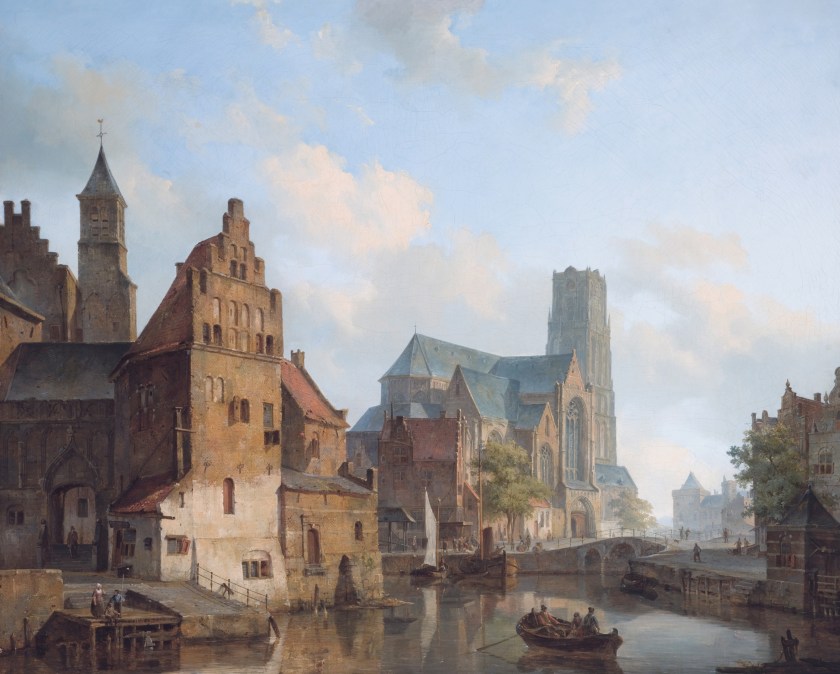
Cornelis Springer: Rotterdam
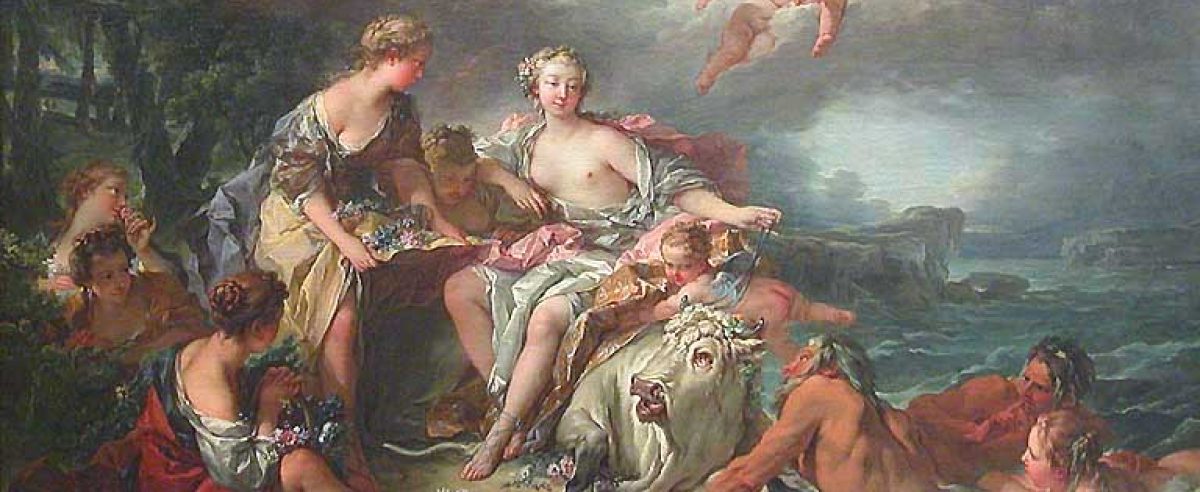
Tidskriften Respons beställde i början av förra året en recension av Sven-Eric Liedmans bok Livstid (Bonniers, 2013). Efter lång tids tystnad förklarades chefredaktören Kay Glans ha ställt sig avvisande när jag levererade den, och ha utförligt redovisat de ståndpunkter som låg till grund för detta – frågan om recensionens publicering skulle utan resultat i form av enighet ha “dragits i långbänk” på redaktionen. Med avsevärd fördröjning publicerar jag därför nu recensionen här.
–
Livstid är en kort bok med personliga betraktelser och reflektioner som skänker ytterligare konturskärpa åt bilden av den kände idéhistorikern Sven-Eric Liedman. Han skriver om sitt eget åldrande och sitt nyfödda barnbarnsbarn. Gestalter ur hans barndomsmiljöer ges stort utrymme. Samtidigt uttrycker han, naturligt nog, sitt eget väsen lika tydligt i tankarna om en rad stora namn i den väster- och delvis österländska kulturhistorien.
Kanske ligger bokens största värde i vad den lär oss om Liedmans intellektuella typ. Han är en av de otaliga som identifierat sig med och på flera sätt förkroppsligar vad som länge kallats den svenska ”kulturradikalismen”. Med den största envishet har denna kvarhållit grundläggande drag alltsedan 1880-talet, men också uppvisat en avsevärd bredd, rörande sig över ett spektrum från socialism till liberalism och över ett annat från naturalism till idealism.
Hos Liedman handlar det ju om kulturradikalismen i dess mer radikala form, som artikulerats som socialistisk och delvis marxistisk vänster, även om vi hos honom också finner reminiscenser från andra delar av dess spektra. Som ofta förr uttrycks tyvärr Liedmans politiska åsikter om samtiden med en bjärt simplism som ofördelaktigt kontrasterar mot hans mer nyanserade historiska reflektioner.
Det är visserligen sant att ”en nyfödd vet inget om pengar men vinsthungriga företag gamar redan efter det värde som hon eller han representerar genom att finnas till som människa”, att ”det välfärdssystem som byggdes upp under 1900-talet” riskerar att bli ”ännu mer likt en maskstungen ost, där riskkapitalisterna borrar sina smarta gångar och förtär allt i sin väg”. Men dessa och liknande formuleringar om hur högern tog kommandot, om smarta vinstmaximerare, om hur livet kom att gå ut på att bli rik, om hur pengar blivit det enda som räknas och hur ord inte har någon betydelse, om hur vi måste återerövra språket från ekonomerna, om klassklyftorna – de förmår inte riktigt gripa tag.
Det är inte bara så att man värjer sig mot det här endast antydda, enkla socialistiska alternativet. Man saknar, förutom den analys långt bortom historiematerialismen som verkligen möjliggör förståelse och förklaring, till och med vissa delar av marxismens teori, som även de i någon mån gör det. Denna brist blir särskilt tydlig när Liedman trots klagomålen om kapitalismens och ”högerns” härjningar naturligtvis utifrån sin ideologiska övertygelse ändå måste bejaka åtminstone mycket i samtidstendenserna som framsteg. Här driver han med vänsterströmmen in i en rad motsägelser, ja mot konvergens med just den kapitalism de blaffigt plakatartade skällsorden fördömer.
I meningen före den om de ”gamande” vinsthungriga företagen som väntar på att slå klorna i den nyfödde sägs det att ”Smartphones och Twitter, Botox och Viagra möblerar den samtid som blir den första för mitt barnbarnsbarn.” Skolpolitiksdebattören känner sig dock trivsamt hemmastadd i denna samtid när han själv entusiastiskt twittrar. På Twitter är det nämligen inte språkligt och intellektuellt utarmade produkter av den nystarka kapitalismen i förening med hans egen ungdoms radikala utbildningsexplosion som fylkas och ängsligt sneglande bekräftar rådande konsensus i krav- och formlös fragmentarism. Liedman förmedlar snarare intrycket att vi finner utpräglade, individuella profiler och karaktärer, den komprimerade formuleringskonstens nya mästare: ”Att skriva något på högst 140 tecken kräver en viss disciplin.” Man utvecklar ”en personlighet som växer fram som en mosaik”. Nåväl, Twitter kan säkert användas till något meningsfullt. Men om man välkomnar Twitter borde man inte som Liedman avfärda Facebook, som åtminstone tillåter verkliga diskussioner med långa inlägg.
Liedman sätter sig på bussen ut till invandrarförorten – kontrasterande den mot sin egen privilegierade Göteborgsstadsdel – för att lära sig arabiska. Vid sidan av den ostentativa politiska korrektheten finns något sympatiskt här. Men förståelsen av invandringen är karaktäristiskt förvirrad. Gårdstens invånare bär på ”minnesbilder av krig, förföljelse, våldtäkt och tortyr”. Det är naturligtvis långtifrån en fullständig bild. ”Vem reste murarna mellan stadsdelarna i Göteborg, i Sverige, i Europa?” Kapitalismen förstås. Men det är ju framför allt den som överhuvudtaget vill ha ett arabisktalande låglöneproletariat här, och ett oerhört mycket större sådant än det som utgörs av flyktingar.
Liedman åker genom ett förfallet, ja förmultnande Vollsjö i Skåne. Där, i den tidigare blomstrande, prydliga byn, hittar han nu ”Sverigedemokraterna”, ”förlorarna”, som skyller på islam, ”araberna, slöjorna”. Vi känner igen detta. Var har vi hört det förut? Vilka är det som mest av alla anstränger sig att sprida denna och liknande ensidiga karikatyrer av invandringspolitikens kritiker? Jo, det är just de gamande, vinstmaximerande, välfärdssönderborrande maskarna i ”högern”.
När Liedman med den nya bombvänstern ondgör sig över den förvisso icke demokratiske men progressive Assads ”krig mot sin egen befolkning”, låter han precis som propagandan från de amerikanska neokonservativa och de NATO-, EU- och andra storkapitalistledare som för sina egna intressens skull mindre stödjer landets egna befolkning än importerade ”rebeller” från de mest extremt reaktionära, förtryckande, förföljande och torterande diktaturerna i arabvärlden. Vi befinner oss plötsligt så långt från kulturradikalismen som det är möjligt att komma i dagens värld.
Nej, i dessa tanklöst konformistiska politiska utfall visar sig 68-farfarsfar inte från sin bästa sida. Det gör han däremot på många andra ställen i Livstid, inte minst avsnitten om Augustinus, Rumi, Caroline Michaelis/Böhme/Schlegel/Schelling, Goethe och Christiane Vulpius, Kierkegaard och Regine Olsen.
Där kommer man att tänka på vad en annan känd idéhistoriker, Svante Nordin, betonat, nämligen att 68-vänsterns akademiska ledare, till skillnad från deras postmarxistiska efterföljare och den utarmning de ofta lämnade i arv till dem, trots allt åtminstone själva erhållit en grundlig historisk skolning och förtrogenhet med klassikerna. Liedman dröjer verkligen vid de senare, för vidare ett självklart värdefullt arv, om än med egna tonvikter och tolkningar. I dessa avsnitt filosoferar han på allvar, liksom han gör det i dem som ägnas hans barndomsmiljöer och dess människor, främst prästen Erik Söderberg, i en grannförsamling till den där Liedmans far var kyrkoherde, en stor bok- och konstsamlare som mot slutet av sitt liv flydde från hustru, pastorat och skulder till Stockholm med en av sina älskarinnor. Den sistnämnda, Herta Viola Magnusson, ägnas för övrigt lika stor uppmärksamhet av Liedman, som inte bara framlyfter kvinnor, utan också programmatiskt parallellställer historiens och samhällets okända med deras kända.
Tiden som sådan är ett tema, ibland litet för stort och svårt för att behandlas träffsäkert. Ett annat, huvudtemat, är livsvalen. Det framlyfts i baksidestexten: ”När vi kommer till världen är scenen för våra liv redan satt. Vi är inga oskrivna blad när vi föds, och tiden och miljön är givna. Men innanför dessa gränser kan vi göra våra livsval och kanske styra vår tillvaro i ny, oväntad riktning.” Här visar sig dock omedelbart en signifikativ oklarhet. Liedman tycks räkna med en verklig frihet. Hur förhåller den sig till arvets och miljöns determinism?
Det sägs mycket om idealistiska, ja rent platonska föreställningar hos Goethe och andra. Liedman representerar inte längre någon militant naturalism. Kanske känner han att det var länge sedan en sådan av politiska skäl behövdes. Han kan skriva med viss nyansering och komplexitet om religionen och mystiken, även om den grundläggande radikala, sekulära omtolkningen består.
Vi påminns om kulturradikalismens icke-naturalistiska gren. Ändå tillhör Liedman inte i första hand den, och hans egen variant tillåter knappast den öppning som kunde filosofiskt förklara livsvalets och styrningens möjlighet. I grunden står naturalismen fast, den dogmatiska slutenheten mot en högre verklighet. Liv efter den kroppsliga döden? ”Nej.” Metafysiken och religionen rymmer för Liedman fortfarande inget som konsten saknar.
Och vad som främst intresserar honom är, tror jag, egentligen hela tiden kulturradikalismens gamla gemensamma, romantisk-emancipatoriska temata: anti- eller åtminstone ickekonventionalismen i Carolines, Goethes, Christianes, Kierkegaards, Erik Söderbergs och Herta Magnussons livsval.
Tvivelsutan fanns historiskt viktiga sanningar i reaktionen mot inskränkt, förljugen konvention och moralism, liksom det även gjorde det på andra punkter av kulturradikalismens kritik. Men sedan många årtionden är det just kulturradikalismen som blivit den nya inskränkta, förljugna konventionen och (pseudo)moralismen. Och det kan inte hjälpas: som självständigt, positivt alternativ framstår dess allmänna, Sverige alltfort dominerande kulturella sensibilitet som fullständigt ohållbar i dess ständigt tilltagande verklighetsförlust.
Inte minst vad som inte kan betecknas på annat sätt än som dess andliga omognad blir slående när dess ständigt mer ensidigt betonade centrala värden, de värden som frigjorts – ”sinnlighet”, ”älskog”, ”vällust” – generation efter generation upprätthålls eller låtsas upprätthållas i hela livstider, in i den höga ålderdomen, av alltmer satyrlika revoltörer mot tingens djupare ordning.
Det finns ofta något betydligt mer förtvivlat krampaktigt här än vad vi finner hos Liedman. Han hyllar heller inte dessa ting på samma stumt grova sätt som exempelvis en Jan Myrdal kan göra. Glädjen är visserligen som ”vällusten”, men den har ”så många fler uttryck”. Och vällusten ”blir bara fulltonig när den delas med en älskad människa”. Men Kierkegaard såg förälskelsen som ”det största i livet”, och Liedman vill i sin tolkning av dennes kända livsstadier återföra den till sinnligheten, via det religiösa stadiets närmande till det estetiska. Han ser inga större manifestationer av kärleken.
Med den älskade ”kan man störta ned i den intighet som kallas den lilla döden. Man är förlorad och ändå kvar. Jag inbillar mig att fromma människor tror att uppståndelsen efter döden ska vara ungefär som uppvaknandet efter en kärleksakt. Själv tror jag att döden är som intigheten när man är nedsövd under en operation.” Liksom mycket annat i kulturradikalismen har denna trots allt fortfarande ensidiga vällustradikalism naturligtvis alltid tjänat och understötts av vinstmaximerarna, och så är mer än någonsin fallet idag. Dess konsekvenser för individen och samhället är oöverskådliga. Dess urskillningslösa befrielse står principiellt i konflikt med traditionell visdom, ja med den humanistiska kulturen i klassisk och högre mening. I historiens större perspektiv är den ett undantag, en abnormitet, en tillfällighet.
Bokens omslag visar en bild av en trollslända. Dess samband med innehållet är oklart. Kanske kan man symboliskt koppla några element ur folktrons sländor till det, men det skulle nog bli långsökt. Vad man först kommer att tänka på när man samtidigt ser bokens titel är väl bara, även om trollsländan inte formellt klassificeras som en dagslända, just det tillfälliga: ett kort, förbifladdrande, lättviktigt, ja obetydligt liv. Och utan tvekan är det precis så många nihilistiska kulturradikaler ytterst uppfattar livet i allmänhet.
Kulturradikalismen uppställer, tvärtemot vad han själv tror, snäva, förminskande gränser för Liedman. Men inom dem skriver han inte sällan läsvärt. Även hans liv och verk är faktiskt betydligt mer än en trollsländas.
Breaking Through the Barrier of Scientistic Belief
Angelico Press/Sophia Perennis, 2008 (1984) Amazon
Book Description:
 In the present work, Wolfgang Smith presents an insider’s critique of the scientific world-view based upon the sharp but often overlooked distinction between scientific truth and scientistic faith. With elegance and clarity he demonstrates that major tenets promulgated in the name of Science are not in fact scientific truths but rather scientistic speculations – for which there is no evidence at all. Step by step the reader is led to the astonishing realization that the specifically “modern” world is based intellectually upon nothing more substantial than a syndrome of Promethean myths. But this is only half of what the book accomplishes. Its primary contribution is to recover and reaffirm the deep metaphysical and religious insights that have come down to us through the teachings of Christianity. And herein lies the true worth of this remarkable treatise: having broken the grip of scientistic presuppositions, the author succeeds admirably in bringing to view great truths that had long been obscured.
Reviews:
“Cosmos and Transcendence is an excellent book, and would be an asset in any course dealing with science and philosophy, or the history of science. It is also most fascinating reading, and would be a welcome addition to any library.” Harold Hughesdon, The Wanderer
“We are astounded to see the revival of philosophical doctrines long thought dead in a scientific context. . . . This book will repay study, especially its brilliant third chapter, ‘Lost Horizons’.” John C. Caiazza, Modern Age
“His chapter on ‘The Deification of the Unconscious’ is superb and totally destroys the pretensions of Jungian psychology…” Rama P. Coomaraswamy, Studies in Comparative Religion
“Having traced the degeneration of the mechanistic outlook into subjectivism and pseudoscience, Dr. Smith concludes his book with a profound reflection on the fall of man and its implications for the pursuit of knowledge…This is a serious work which will repay close attention.” Robert P. Rooney, Homiletic & Pastoral Review
“This is a very interesting book for the general reader as for the scientist.” Fellowship of Catholic Scholars Newsletter
“Wolfgang Smith is as important a thinker as our times boast.” Huston Smith, author of The World’s Religions
About the Author:
Wolfgang Smith graduated from Cornell University at age eighteen with majors in physics, philosophy, and mathematics. After taking an M.S. in physics at Purdue, he pursued research in aerodynamics, where his papers on diffusion fields provided the theoretical key to the solution of the re-entry problem for space flight. After receiving a Ph.D. in mathematics from Columbia University, Dr. Smith held faculty positions at M.I.T., U.C.L.A., and Oregon State University, where he served as Professor of Mathematics until his retirement in 1992. In addition to numerous technical publications (relating to differential topology), Dr. Smith has published three previous books and many articles dealing with foundational and interdisciplinary problems. He has been especially concerned to unmask conceptions of a scientistic kind widely accepted today as scientific truths.
 von Schéele, Frans, f. vid Pärsbergs gruvfält i Värmland d. 31 juli 1853, avlade mogenhetsexamen i Gävle och blev student i Uppsala 1873, fil. doktor 1885, docent vid samma universitet i estetik s.å., i praktisk filosofi 1887, erhöll efter att hava varit uppförd på förslag till professur i Göteborg och Lund professors n.h.o.v. 1903, lämnade 1905 sin docentverksamhet i Uppsala, sedan han utnämnts till förste inspektör vid Stockholms folkskolor, vilken befattning han innehade till 1918, då han avgick med pension. Sin filosofiska bildning fick han såsom lärjunge av Ribbing, Sahlin och Wikner inom den boströmska skolan. I sin gradualdisputation Samuel Grubbes skönhetslära (1885) sökte han uppvisa den historiska ställning, som Bosröms närmaste föregångare intagit inom den filosofiska estetiken, och i avhandlingen Kan Gud tänkas såsom vilja? (i Upps. univ:s årsskr. 1887) sökte han från den boströmska filosofiens ståndpunkt härleda ett nekande svar på denna fråga. Men så småningom rubbades hans tro på möjligheten att på sådan abstrakt väg lösa de filosofiska problemen, och han utvecklade i avhandlingen Filosofiens uppgift, metod och betydelse (i Filosofiska studier I, 1899) en uppfattning, som mera sökte närma filosofien till erfarenheten. Sitt huvudintresse ägnade han sedan åt den empiriska psykologien, inom vilken han utgav den första svenska vetenskapliga handboken Det mänskliga själslivet (1904-06) och en kortfattad Lärobok i psykologi (1899; 2:dra uppl. 1914). Under senare år har han ägnat sig åt pedagogiken, inom vilket ämne såsom modern vetenskap S. varit en av de första vetenskapliga representanterna i vårt land.
Alf Ahlberg, Filosofiskt lexikon (1925)

“It is not the function of this book to defend Traditionalism, but it seems clear that those who condemn Traditionalism as not serious are missing the point”, Mark Sedgwick writes in the final paragraph of the concluding chapter of his Against the Modern World: Traditionalism and the Secret Intellectual History of the Twentieth Century (2004); “Traditionalism makes a claim to represent the ultimate truth, just as religion or some types of philosophy do.” [Op.cit. 271.]
Those who condemn traditionalism as “not serious” are of course the non-traditionalist scholars, from Sylvain Lévi, who rejected Guénon’s Sorbonne doctoral thesis in 1921, to the pioneer of the renewed study of Western esotericism at the Sorbonne, Antoine Faivre, who is quoted by Sedgwick as saying that traditionalism “de-historicizes and de-spatializes its ontological predicates…Its propensity to search everywhere for similarities in the hope of finally finding a hypothetical Unity is evidently prejudicial to historico-critical research, that is to say empirical research, which is more interested in revealing the genesis, the course, the changes, and the migrations of the phenomena it studies.” [Ibid.]
At the same time, Sedgwick notes that “the entire field of contemporary religious studies bears the imprint of Eliade’s soft Traditionalism, and many leading Traditionalists have been scholars.” [Ibid.]
In important respects, Guénon’s thesis is certainly flawed, and it is perfectly understandable that it was rejected by an academic institution devoted to “historico-critical research”, “empirical research”, an institution that was “more interested in revealing the genesis, the course, the changes, and the migration of the phenomena it studies.” There are simply empirical errors of the kind historico-critical research cannot accept. “Guénon did submit his work to Lévi as a thesis, and so Lévi was right to recommend its refusal.” [Ibid.]
But Sedgwick is nonetheless right that critics like Lévi and Faivre miss the point, inasmuch as “the claim to represent the ultimate truth, just like religion or some types of philosophy do”, is not dependent on the positions or minor claims shown by critical scrutiny to be erroneous. “To judge Traditionalism as one would a university thesis”, Sedgwick says, “makes no more sense than to dismiss Christianity for having insufficient evidence of Christ’s divinity, or to dismiss Islam for ignoring crucial elements of the doctrine of the Trinity.” [Ibid.] But it also makes no more sense than condemning any claim to represent the ultimate truth in philosophy. In other academic institutions, or other departments of the same institutions, it would have been, and still is, perfectly legitimate to claim to represent the ultimate truth, although the modality of such claims is not precisely that of Guénon. Philosophy does it all the time, including philosophy which rejects the ultimate truth, i.e. claims to represent the ultimate truth that there is no ultimate truth.
For me, it is obvious that both pursuits are legitimate and that there should be no contradiction between them. Guénon should have avoided the historical errors, and perhaps avoided presenting his kind of study in a department devoted to historico-critical research. But it is quite as illegitimate, and in principle impossible, for historico-critical research to reject all studies that set forth non-historical and non-spatialized ontological predicates, which searches for similarities, which postulates a unity, as “evidently prejudicial” to itself. It is perfectly legitimate and indeed necessary to be “interested in” – even “more interested in” – other things than revealing the genesis, the course, the changes, and the migrations of phenomena. And it is so not only in religious institutions, but also in academia. The formulation about de-historicizing and de-spatializing ontological predicates is actually absurd, a clear illustration of the kind of historicist misunderstanding and distortion Guénon so sharply criticized.
Traditionalism and its claim to represent the ultimate truth must be judged in terms of philosophy, theology, and spiritual experience, and there is no theoretical contradiction in pursuing this judgement as a scholarly activity alongside historico-critical and empirical study of the respective traditions from which the debris is reassembled. From the scholarly point of view, in the regard that is here relevant, there is no formal difference between what the traditionalists and any philosopher or theologian is doing. And already from Sedgwick’s assessment, it is clear that their achievement is considerable – so considerable, in fact, that it is an open question whether or not it will in the future succeed also in its most ambitious project, that of reestablishing Western civilization on the basis of spiritual tradition, or at least in making a decisive contribution to this.
This is not to say that I agree with all of the positions of Guénon and his many followers; my readers, or at least those who have studied more closely my texts relevant to these issues published here or elsewhere, will know this is not so. It is rather the basic concepts and the general framework of traditionalist thought that I agree with and affirm. Which, in turn, means that the modifications and supplementations I would like to introduce are such as can be introduced within this same framework, that they are congruent with traditionalism, or a kind of creative traditionalism.
Can we know something of the ultimate truth? Is such knowledge important to us? Is there spiritual insight, wisdom, knowledge, realization? Are there timeless truths about human life that are related to these things? Is such insight etc. in fact decisive, does its achievement define the ultimate meaning of existence? Does that knowledge need to be transmitted, even perhaps to some extent institutionalized? Is it necessary to reestablish and acknowledge an authority that represents such truth?
Those are the obvious questions, or challenges, that arise in the minds of the students of the traditionalists in the modern, postmodern, and post-postmodern world. Or rather, they arise in the minds of those who come in contact with truth in any major religious tradition, or even in any serious spiritual teacher or writer more loosely connected with those traditions. But the traditionalists provide a more “complete and internally coherent” perspective than most others, a pespective in the light of which the questions can be more easily understood and in which the answers will more clearly emerge. And they are questions which can be not only explored, but to which answers can be set forth, both within and without academia.
For those who, like me, insist that the answer to the questions is yes, the traditionalist school should, I think, always be of central importance. It is obvious that there is truth, even ultimate truth, to be found in all major traditions and elsewhere too, and it is of course a basic and natural operation of intellect to compare and coordinate truth found in one place with truth found in another, quite regardless of time and space; and the interpretations made and the conclusion drawn by the traditionalists in terms of tradition and transcendent unity may simply be understood as elaboration on the basis of the necessary philosophical premise that “things are the way they are”.
One of the merits of Sedgwick’s book – despite its being generally critical of the school – is that it shows that traditionalism was not as entirely new as it has long appeared to many readers, especially of Guénon. This impression was of course produced by Guénon’s and his followers’ – primarily of course the “hard” traditionalists – sharp criticism of modern Western thought; it obscured the fact that much of the origins of his own position are nonetheless found precisely there, and precisely in the currents he devoted his most extensive, separate studies to refuting: the renewed forms of idealism and esotericism which first, and most eagerly, absorbed the newly discovered or rediscovered teachings of the East from the late 18th and through the 19th centuries. These currents in turn built on the legacy of Western Platonism and of the Western esotericism, not least since the Renaissance, that has been so richly explored in recent decades by scholars like Faivre.
Sedgwick does play down unduly the originality of Guénon’s criticism, but he is right that traditionalism is in many respects a historically comprehensible intrinsic development of Western thought. But it is the kind of Western thought that also seeks to assimilate and incorporate the truth of certain other traditions. As such, traditionalism too, in itself, as such, should be studied with the same historico-critical methods as are applied to its interpretations of the traditions it appropriates. And there is no contradition in holding that it should also, as I suggest, be selectively affirmed as a Western school that to a considerable extent succeeds, at least on a general level, in its aims.
For both of these purposes, I have always tried consistently to discuss it in terms of or at least in relation not only to the Western Platonic tradition in a broad sense, but also to modern, 19th century Western idealism. But I also find it desirable to transcend the obvious limitations and curiosities of Western esotericism, and to go, as far as possible, directly to the “Vedic” tradition in the broad sense sometimes accepted today, i.e. to the major darshanas and sampradayas as in various ways transposed and represented in the West today – and in this I am following Guénon’s main intention precisely in his thesis, which was subsequently published as his first book.
On the basis of its reassembling the elements, or at least some elements, of what it conceives to be and coherently presents as a primordial tradition, traditionalism thus credibly makes the claim to represent at least some aspects of the ultimate truth. The “many leading Traditionalists” who not only have been but still are scholars should be perfectly able to present that claim in academia in a way that does not conflict with the established canons and results of historico-critical research.
Mark Sedgwick on Sylvain Lévi’s Criticism of Guénon’s Thesis
(See the Contents and References pages for more traditionalism-related posts.)
Click and double-click to enlarge
Disappointed both in his quest for pseudo-divine self-glorification and pseudo-divine self-annihilation, the romantic settled for cynical and/or sensualist naturalism. This was one of the ways in which the dialectic of the two wings of modernity was carried on, and rationalism and scientism, at length, reasserted themselves. The transformation into scientistic materialism was implicit in the pantheism of both rationalism and romanticism, and it was worked out, in different fields of thought and knowledge, primarily by the Young Hegelians, the French utopian socialists, and naturalists like Taine, Renan, and Haeckel, who in their very scientism are still typical romantic pantheists.
After the interlude of impersonalist idealism’s threat of absorbing the person into ideas, the person was thus again faced with the threat of being absorbed into matter. We are talking here about the most palpably concrete social realities, in the era of nationalism and incipient industrial warfare. Idealism was distorted and transformed into naturalism. In new spectacular forms of undiminished extremism, the two wings of modernity continued to spur each other on to further excess, locked in the fatal and by now centuries-old anti-differentiational dialectic in which the reality and the values of the person were ever insecure.
Heretical pantheism has become the orthodoxy of the modern West. It is not that this new pantheism denies that pantheism is older than Platonism and Christianity. The idea of a primitive pantheism appears in innumerable speculations, scientific as well as popular. Yet these speculations are decisevely shaped by specifically modern presuppositions. Not least, the whole speculative interpretation of history is an exclusively modern phenomenon. The intention of the modern pantheist’s progressivism is partly what is perceived as a “restoration” of what is perceived as original non-differentiation. But the meaning and nature of the non-differentiation of early pantheism is radically transformed by the romanticization, as mere compactness, i.e. non-differentiation or rudimentary differentiation, is replaced by principled, nihilistic anti-differentiation. Modern pantheism is sui generis.
Pantheism thoroughly shaped modern liberal theology, and in the characteristic form of Kulturprotestantismus, Christianity increasingly ignored its traditional concern with personal salvation and turned towards immanent objectives and secular culture: the moralism of sentimental humanitarianism, philanthropy, social involvement, and political activism. As the world set the agenda of the Church, salvation, faith, and spirituality receded. Significantly, it was all done through the standard device of reinterpretation of the very meaning of salvation, faith, and spirituality.
Without exception, the secular Ersatz religions of modernity tended to reduce man to the lower levels of reality, the levels which did not constitute his personhood. [For a Voegelinian intellectual history of the secular political religions, see Michael Burleigh, Earthly Powers: The Clash of Religion and Politics in Europe from the French Revolution to the Great War (London: Harper Collins, 2005); this volume was followed by a second part on the twentieth century: Sacred Causes: The Clash of Religion and Politics, from the Great War to the War on Terror (2008). The work is not without its flaws, and the relation between those flaws and Voegelin’s positions are worth analysing at some length, but this cannot be done here.] Born of the most high-flown romanticism, Marxism set forth a new, dynamized materialism, and denigrated the individual to the point of proclaiming the essence of man to be his true collectivity. Soon the doctrine was put into practice through the liquidation of unessential individuals by the millions.
All the while utopians in the West ignored this and played it down, and countless philosophers insisted, unperturbed, on their own increasingly totalitarian system in the theoretical form of positivistic and neo-positivistic, reductive scientism and utilitarianism and in the practical form of manipulative social engineering. High modernism and psychoanalysis set about revealing the weakness of the bourgeois remnants of the modern rational self through new aesthetic and therapeutic means. Primitivity and violence were celebrated. Capitalism still partly inspired by the individualism of classical political economy continued to shape the history of one half of the world, while the other succumbed to the new totalitarian collectivisms. In its new, existentialist form, individualist “freedom” itself was used by Sartre to support one of the latter.
By many strategies, the differentiational framework which had made possible the understanding of the person and its values was thus gradually dismantled. When the experience of the metaxy was obscured or made impossible, and its institutional embodiment and transmission abolished, it could no longer inspire order in the soul and order in society, and thus withstand and restrain the pantheistic revolution. Destroying the differentiation that is the person’s precondition, the closed immanence of secular modernity, in all of its versions, revealed itself as a threat to the person.


 Jan Olof Bengtsson