Comments on Boström

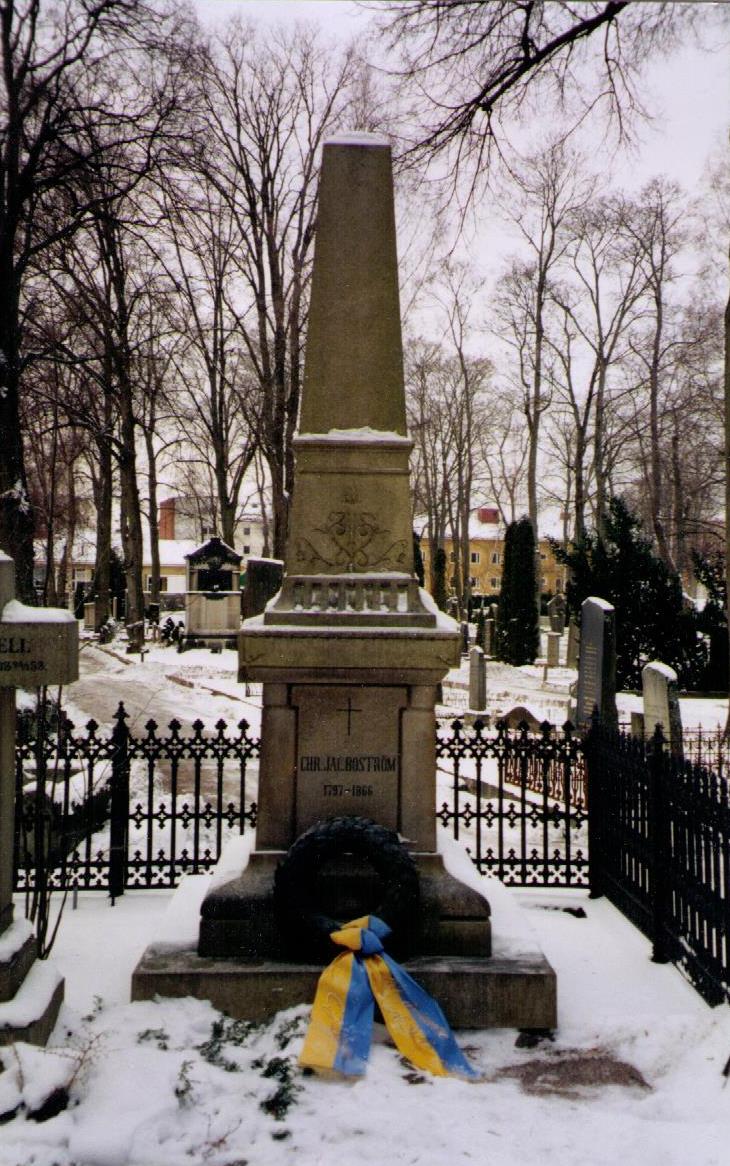
In my introduction to Lawrence Heap Åberg’s Den Boströmska världsåskådningen (The Boströmian Worldview) from 1882, which I published as a long series here, I mentioned that I would come back with a few comments of my own, and I think that in a discussion with a reader who commented on one of the early parts in the series this was developed into a promise. I will now therefore start a new series of posts with some comments on Heap Åberg’s introduction, in which selected passages will be translated into English.

Readers of my book The Worldview of Personalism (2006) will be familiar with some of the positions of Christopher Jacob Boström, the leading Swedish 19th-century philosopher. A general introduction is found in Robert N. Beck’s long essay published together with the translation of Boström’s Philosophy of Religion by Yale UP in 1962. The character of Boström’s own writings, however, is such that it is almost inevitable, if something of the substance of his worldview is to be successfully communicated to the philosophically interested reader of today, to take as the point of departure one of the many available introductions to his work. Moreover, my purpose is merely to present in broad outline and to make comprehensible some of Boströms basic and essential idealistic positions.

Much attention has been given by Swedish historians of philosophy to the special, detailed positions of Boström’s theory of the state (his statslära) as related to his idealist metaphysics, positions which are of no significance and have often obscured the meaning of his more general idealist positions. They can, however, easily be ignored in the study of his philosophy, and that is also what Heap Åberg does: all such things are simply left out – the author clearly saw the need for this already at the time of writing his introduction, i.e. in the early 1880s.

It is only with reference to the general, central positions of Boström that I claim that his philosophy, or rather, perhaps, that of his school, in which many of his positions were improved upon, remains not just important and relevant, but in some respects superior to all later philosophy that has not, by different means, reached the same insights. And very few professional philosophers have reached such insights. Those who have done so have done it through the traditions by means of which I too seek to supplement and modify Swedish idealism, and also, for that matter, to supplement the elements of other 19th- and early 20th-century forms of idealism that I also try to assimilate. I.e., primarily through aspects of the broad and deep current of Platonism, or, more precisely, Neoplatonism, and also through Vedanta and some Buddhist schools.

Such supplementation and modification is necessary: the Boströmian school, and the broader Swedish idealist tradition to which it belongs, is of course imperfect and displays weaknesses, as do all modern systems. But its basic orientation is correct, it is on the right path, its essential intuition is a true one. The philosophical way ahead – and this is one of my modest main theses – is not via any break with its idealist assumptions, in any of the forms that came to dominate in the second half of the 19th century and the first half of th 20th (neokantian, pragmatic, Hägerströmian, positivist, phenomenological, historicist, materialist, analytical, Marxist, hermeneutic, vitalist, psychological), but only through partial correction, general deepening, and further development.

As many scholars are now realizing, the rupture with idealism involved gross misunderstandings of idealism on all levels, as well as of philosophy in general and not least its relation to the sciences. It meant an obvious step back in the understanding of reality and hence in the general level of culture; indeed, not seldom deep illusion, confusion and decadence.

In comparison with the main positions of idealism as we find them in the main Swedish current, later modern philosophy has merely, at its best, provided minor, relatively marginal truths and formal instruments of thought. And for their value to be properly assessed and rightly understood, they must be connected to and seen in the light of the lost idealist perspective – i.e., the later must be reconstructed or rediscovered.

Now, it is of course possible to reach the basic truths of the worldview to which I seek to draw the reader’s attention through the other schools and traditions I mentioned, and, again, I draw on them myself. But there is no reason, in Sweden, to keep exclusively to them and not to connect to the history of our own philosophy and to our own leading thinkers. German idealism never died; British idealism has been revived. Now Swedish idealism needs to be rediscovered and renewed.

Not least German idealism is of course more richly developed in many respects than Swedish idealism. But it is also quite different, as not least the Boströmians kept insisting. While Swedish idealism is certainly not as fully elaborated in all of the special branches of philosophy, it at least has a certain strict continuity in its development and a considerable sharpness of profile in most of them. And, not least, it is more completely and consistently idealistic, in a way that brings it closer to the great, earlier traditions than most other forms of “modern” idealism in the west.

It is, I submit, not least in this that we find its strength, and that which makes it quite as relevant and important as anything else that is currently being rediscovered by philosophers and historians of philosophy in the rich but forgotten currents of idealism. At least those with a sufficiently broad overview of the history of human thought will, I hope, quickly see that there is in fact nothing strange about this claim. The exclusive dominance of the characteristic 20th-century schools was spatio-temporal provincialism.

Edward F. Kelly, Adam Crabtree & Paul Marshall, eds: Beyond Physicalism

Toward Reconciliation of Science and Spirituality

Rowman & Littlefield, 2015

Publisher’s Description:

KellyThe rise of modern science has brought with it increasing acceptance among intellectual elites of a worldview that conflicts sharply both with everyday human experience and with beliefs widely shared among the world’s great cultural traditions. Most contemporary scientists and philosophers believe that reality is at bottom purely physical, and that human beings are nothing more than extremely complicated biological machines. On such views our everyday experiences of conscious decision-making, free will, and the self are illusory by-products of the grinding of our neural machinery. It follows that mind and personality are necessarily extinguished at death, and that there exists no deeper transpersonal or spiritual reality of any sort.

Beyond Physicalism is the product of an unusual fellowship of scientists and humanities scholars who dispute these views. In their previous publication, Irreducible Mind, they argued that physicalism cannot accommodate various well-evidenced empirical phenomena including paranormal or psi phenomena, postmortem survival, and mystical experiences. In this new theory-oriented companion volume they go further by attempting to understand how the world must be constituted in order that these “rogue” phenomena can occur. Drawing upon empirical science, metaphysical philosophy, and the mystical traditions, the authors work toward an improved “big picture” of the general character of reality, one which strongly overlaps territory traditionally occupied by the world’s institutional religions, and which attempts to reconcile science and spirituality by finding a middle path between the polarized fundamentalisms, religious and scientific, that have dominated recent public discourse.

Contributions by: Harald Atmanspacher, Loriliai Biernacki, Bernard Carr, Wolfgang Fach, Michael Grosso, Michael Murphy, David E. Presti, Gregory Shaw, Henry P. Stapp, Eric M. Weiss, and Ian Whicher.

Reviews:

“The Sursem project has been, in recent times, the longest lasting and most intellectually substantial enquiry into rogue phenomena. It has resulted in [a] mammoth work…Beyond Physicalism – a volume that not only provides much food for thought but is in itself a feast of thinking.”  Network Review

Beyond Physicalism presents a serious challenge to physicalism from psychologists, neuroscientists, physicists, philosophers, and Eastern scholars. This volume is no ‘New Age’ pap with easy answers, but it carefully considers so far intractable issues; and, it demands careful and repeated Readings…Beyond Physicalism should interest readers who are willing to consider the intricacies and extraordinary nature of consciousness, rather than dismissing them offhand. No doubt some of the ideas covered in the book will be shown to be limited…but they seek to provide a comprehensive explanation of mind and matter that has been lacking in most discussions until now. Beyond Physicalism does not offer a definitive theory, but it describes serious alternatives to materialism. The appropriate reply by the holders of the latter position should be not to ignore the phenomena explained by these alternatives, as they have usually done so far, but to advance a better materialist position to explain them. Will they take up the gauntlet?”  PsycCRITIQUES

Beyond Physicalism heralds an impending shift of epic proportion in humankind’s efforts to understand the nature of reality, and potentially the most significant advance in the recent history of the mind-body debate. This landmark book provides an unprecedented synthesis of science, psychology, philosophy and theology, approaching the deeper truth of all existence.”  Eben Alexander III, MD, neurosurgeon and author of Proof of Heaven and The Map of Heaven

“Finally, a book that conclusively demonstrates that it is possible, in fact preferable, to reconcile genuine science with spirituality. Drawing upon a massive amount of compelling empirical data, and weaving together several interrelated and extremely thoughtful theoretical perspectives offered by a range of highly respected scientists and humanists, Beyond Physicalism articulates a cogent and compelling alternative to the distorted ‘all or nothing’ dichotomy between a narrow-minded religious fundamentalism and an equally dogmatic and rigid scientistic mentality.”  G. William Barnard, professor of Religious Studies, Southern Methodist University

Beyond Physicalism lays several stones for the foundation of a new world-view. No book has gone further toward reconciling science and spirituality.”  William Eastman, former director of SUNY Press

“In this wonderful sequel to Irreducible Mind: Toward a Psychology for the 21st Century, ‘rogue’ phenomena that are the essential facts denied by psychology too long mired in varieties of physicalism are rightly accepted as empirical fact. Abandoning neither the truths of science nor those of religion, evolutionary panentheism provides the tertium quid that that can steer us safely home. This is a must read book. Marvelous!”  Ralph W. Hood Jr., professor of Psychology, University of Tennessee at Chattanooga and former editor, Journal for the Scientific Study of Religion

“Dogmatic materialists, sometimes called skeptics, claim that to accept the possibility of any non-physical force or entity requires that we sacrifice all of modern science. No matter the apparent evidence, we are told, the future of scientific progress and rationality are at stake. Creationism and the flat Earth lie in wait. Beyond Physicalism, however, presents both solid empirical evidence and fully rational theoretical views demonstrating that the materialist’s dichotomy is false. This book offers a third way, reconciling science and spirituality without diluting either. Robust and evidence-based, this work by highly respected scholars and scientists demolishes orthodoxies right and left, allowing the reader a way forward past the Scylla and Charybdis of religious and scientific fundamentalisms.”  David J. Hufford, professor emeritus, Penn State College of Medicine

“Beyond Physicalism is much more than a book. It is the intimate expression of a decade and a half of critical but collegial conversations between established scientists and professional humanists around some of the most important but still unsettled questions facing humanity: those involving the nature of mind or consciousness – that is, the nature of us.”  Jeffrey J. Kripal, J. Newton Rayzor Professor of Religious Studies, Rice University

“Beyond Physicalism is an eye-opening (perhaps one might be permitted to say ‘soulful’) collection of essays by disciplined researchers who seek to develop a credible conception of the spiritual nature of human beings. The authors are hard-nosed scientists and humanistic scholars who believe it is possible to reject the ‘old man in the sky pulling the strings’ version of theism without embracing dispiriting contemporary versions of materialism.”  Richard A. Shweder, Harold Higgins Swift Distinguished Service Professor, Department of Comparative Human Development, University of Chicago

“Some of the philosophical problems that occupied William James longest and deepest, along with solutions he thought most promising, have literally been written out of history. This volume presents the first serious collective attempt since James’ death to revive his project. Its chapters are characterized by an intellectual ethos reminiscent of the ‘father’ of modern American psychology himself: sympathetic open-mindedness made fruitful through disciplined, calm and penetrating rigor.”  Andreas Sommer, junior research fellow in history and philosophy of science, Churchill College, University of Cambridge

“If you are personally content thinking of yourself as a meaningless byproduct of accidental chemical reactions, what I’ve called the Total Materialism view of reality, and think you’re superior for being so “scientific,” you don’t want to read this book, not that you can actually freely make a choice, because it will upset you and you’ll need some tranquilizing drugs to calm your agitated brain. But if you believe facts are more important than currently fashionable scientistic theories and wonder about the spiritual side of human nature, you will find this volume fascinating!”  Charles T. Tart, professor emeritus of psychology, University of California, Davis

“I see this book as a landmark publication that may help to catalyze two urgently needed, radical transformations in modern civilization. The first is the first true revolution in the mind sciences, which is bound to have profound repercussions all the way down to the foundations of physics. The second is a renaissance in the world’s great contemplative traditions. Both science and spirituality need to return to a spirit of open-minded, radical empiricism, casting off the shackles of dogmatic metaphysics, whether materialistic or religious.”  B. Alan Wallace, physicist and Buddhism scholar, president of the Santa Barbara Institute for Consciousness Studies

“When I first encountered Kelly and colleagues’ first book, Irreducible Mind, I enthusiastically read all 800 pages, excited to see a book that so carefully documented the research that supports the notion that consciousness is not simply a product of neural activity. When I completed the book, I wanted to know more. I wanted to know details of a theoretical framework they had alluded to, which might include both mystical experiences and scientific understanding of consciousness within one ‘big picture’. Their second book, Beyond Physicalism, brings together key scholars in the areas of quantum physics, psychology, Asian philosophy and mysticism to thoughtfully explore ways that mystical and psi experiences can fit into an expanded scientific worldview.”  Marjorie Hines Woollacott, professor, Department of Human Physiology and Institute of Neuroscience, University of Oregon

About the Editors:

Edward F. Kelly is a research professor in the Department of Psychiatry and Neurobehavioral Sciences at the University of Virginia, with interests in psychical research and functional neuroimaging. He is lead author of three previous books: Computer Recognition of English Word Senses; Altered States of Consciousness, and Psi: An Historical Survey and Research Prospectus; and Irreducible Mind: Toward a Psychology for the 21st Century.

Adam Crabtree is a psychotherapist in private practice and on the faculty of the Centre for Training in Psychotherapy in Toronto, with interests in the history of animal magnetism and hypnotism, as well as the history and practice of psychodynamic psychology. He is author of six books including From Mesmer to Freud: Magnetic Sleep and the Root of Psychological Healing; Multiple Man; and Memoir of a Trance Therapist.

Paul Marshall is an independent researcher with interests in mysticism, philosophy and psychology of religion, science-religion relations, and consciousness studies. He is author of two previous books, The Living Mirror: Images of Reality in Science and Mysticism; and Mystical Encounters with the Natural World: Experiences and Explanations.

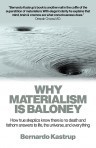
Bernardo Kastrup: Why Materialism Is Baloney

How True Skeptics Know There Is No Death and Fathom Answers to Life, the Universe, and Everything

Iff Books, 2014

Publisher’s Description:

KastrupThe present framing of the cultural debate in terms of materialism versus religion has allowed materialism to go unchallenged as the only rationally-viable metaphysics. This book seeks to change this. It uncovers the absurd implications of materialism and then, uniquely, presents a hard-nosed non-materialist metaphysics substantiated by skepticism, hard empirical evidence, and clear logical argumentation. It lays out a coherent framework upon which one can interpret and make sense of every natural phenomenon and physical law, as well as the modalities of human consciousness, without materialist assumptions. According to this framework, the brain is merely the image of a self-localization process of mind, analogously to how a whirlpool is the image of a self-localization process of water. The brain doesn’t generate mind in the same way that a whirlpool doesn’t generate water. It is the brain that is in mind, not mind in the brain. Physical death is merely a de-clenching of awareness. The book closes with a series of educated speculations regarding the afterlife, psychic phenomena, and other related subjects.

About the Author:

Bernardo Kastrup has a Ph.D. in computer engineering with specializations in artificial intelligence and reconfigurable computing. He has worked as a scientist in some of the world’s foremost research laboratories, including the European Organization for Nuclear Research (CERN) and the Philips Research Laboratories (where the “Casimir Effect” of Quantum Field Theory was discovered). Bernardo has authored many scientific papers and philosophy books. His three most recent books are: More Than Allegory, Brief Peeks Beyond and Why Materialism Is Baloney. He has also been an entrepreneur and founder of a successful high-tech start-up. Next to a managerial position in the high-tech industry, Bernardo maintains a philosophy blog, a video interview series, and continues to develop his ideas about the nature of reality. He has lived and worked in four different countries across continents, currently residing in the Netherlands.

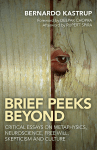
Bernardo Kastrup: Brief Peeks Beyond

Critical Essays on Metaphysics, Neuroscience, Free Will, Skepticism and Culture

Iff Books, 2015

Publisher’s Description:

KastrupThis book is a multi-faceted exploration and critique of the human condition as it is presently manifested. It addresses science and philosophy, explores the underlying nature of reality, the state of our society and culture, the influence of the mainstream media, the nature of free will and a number of other topics. Each of these examinations contributes an angle to an emerging idea gestalt that challenges present mainstream views and behaviors and offers a sane alternative. The book is organized as a series of short and self-contained essays, most of which can be read in under one hour.

About the Author:

Bernardo Kastrup has a Ph.D. in computer engineering with specializations in artificial intelligence and reconfigurable computing. He has worked as a scientist in some of the world’s foremost research laboratories, including the European Organization for Nuclear Research (CERN) and the Philips Research Laboratories (where the “Casimir Effect” of Quantum Field Theory was discovered). Bernardo has authored many scientific papers and philosophy books. His three most recent books are: More Than Allegory, Brief Peeks Beyond and Why Materialism Is Baloney. He has also been an entrepreneur and founder of a successful high-tech start-up. Next to a managerial position in the high-tech industry, Bernardo maintains a philosophy blog, a video interview series, and continues to develop his ideas about the nature of reality. He has lived and worked in four different countries across continents, currently residing in the Netherlands.

In Defence of the Personal Idealist Conception of the Finite Self, 1

In the writing of British idealists on the finite self, there was no terminological uniformity. The same conceptual issues were discussed under different terminologies. But it is important to keep in mind the conceptual differences between self, individual, subject, and person, which, I suggest, must be understood, even for purely philosophical purposes, partly in terms of the process of historical development and definition, i.e., in terms of conceptual history.

Above all, we should keep in mind their conceptual complementarity, the way in which they supplement each other and describe different aspects of the same thing. But it is a fact that the British idealists often did use these different terms – in the sense of words – in a more vague and general manner for the same concept. Hence we find to this day an unnecessary confusion produced by an insufficient conceptual differentiation. The finite self was often used synonymously with the finite individual, the finite person, and the finite subject. Yet the conceptual complementarity is not only necessary for the full articulation and comprehension of the position of the personal idealists in a way they are not always in the case of their non-personal or impersonal idealist opponents. Properly defined, the terms can perhaps even to some extent in themselves be said to contribute to settling the philosophical disputes.

Bosanquet and Seth Pringle-Pattison [Hereinafter: Pringle-Pattison] debated the “finite individual”, a terminological preference that, as William Mander emphasizes in his analysis of their debate, [W. J. Mander, ‘Life and Finite Individuality: The Bosanquet/Pringle-Pattison Debate’, British Journal of the History of Philosophy, 13:1, 2005.] is explained by Bosanquet’s general definition of the individual. Maintaining both the etymological and Aristotelian meanings, the individual is for him that which is indivisibly one, and the primary substance. But this is strictly, according to Bosanquet, “in the ultimate sense” applicable only to the whole, the absolute. [Bernard Bosanquet, The Principle of Individuality and Value (1912), 72.] The true individual cannot be finite since the finite is that which is limited from outside. Yet the totality is for Bosanquet not really unlimited, but limited from within, as it were, as exclusively self-de-fining. When the term infinite is still used in this connection, it thus seems at the very least terminologically infelicitous inasmuch as, etymologically, unlimited and infinite mean the same thing.

The finite individual, as finitized from without, cannot really be accepted as a true individual at all. For Bosanquet, only the individual that is the absolute is ultimately real; the finite individual Bosanquet accepts as individual only in a secondary sense; it has only an “adjectival” mode of existence, it is an “adjective” of the real individual that is the totality. But here we may see merely the misleadingly reductive effects of the terminological preference, which leaves out some distinctive conceptual content of the supplementary terms.

The finite individual does not have to be a self, a subject, a person. If it is not, it is of course more easily reducible to an adjective, a property, a determination of the whole, and the adjectivity constituting its only significant identity, intelligibility and indeed mode of existence. Even the application of this analysis to the kind of finite individual that is also a self, a subject, and a person is certainly valid in itself as far as it goes, although it is incomplete and only one perspective among others that are equally necessary for its full comprehension. Pringle-Pattison says, for instance, that he accepts the adjectival theory inasmuch as its meaning is the “denial of unrelated reals”. [Andrew Seth Pringle-Pattison, The Idea of God in the Light of Recent Philosophy (1920 (1917)), 274.] It is obvious that any individual thing qualifies or characterizes the whole, and it is indeed true that any finite phenomenon can only be properly understood as a part of the whole, in the sense that it is a property, a quality of that whole, part of a scale of parts and partial wholes leading up to the totality. Here, as in the general progress of conscious experience and knowledge, any arrest in its continuously broadened and simultaneously deepened apprehension is certainly merely provisional and conventionally motivated for experientially and epistemologically “modal” purposes in Oakeshott’s sense. [Michael Oakeshott, Experience and Its Modes (1933).]

For this reason, if the basic understanding of the perspectival complementarity is accepted and preserved, and the “individual” perspective as this far discussed is included as one of many – this being of course fully coherent with the most basic assumptions of idealism in general – my impression is that the personal idealist position does not even require the rejection that we find in Pringle-Pattison of Bosanquet’s theory of judgement. In the latter, the totality is said to be the only logical subject: “Reality is such that at or in S it is P” does say more than “S is P”, even in the case where S, or P, is not only an individual but a self, a subject, and a person. Mander uses this as a summary description of Bosanquet’s position regarding his basic understanding of the ultimate nature of judgement; [Mander, op.cit.] but many complementary formulations of it are found in Bosanquet’s works. What I find important here, and in reality congruent with personal idealism, is the general idealist understanding expressed in Bosanquet’s formulation of the importance of the process of thought as approximation of the totality. I am not making any claims about the details of Bosanquet’s specific understanding of judgement, induction, or indeed logic in general; this general understanding is better discussed, in line with Pringle-Pattison’s own earlier practice, in terms of “Hegelianism” in general. [See Andrew Seth Pringle-Pattison, Hegelianism and Personality (1887), published under the name Andrew Seth.]

The general understanding might become problematic, however, when, as in Bosanquet, all finite individuals are said to have their main being and value as mere qualifications of the whole. For then, in line with Bosanquet’s understanding of the totality in terms of individuality, the radical monistic tendency that follows from the definitional emphasis on indivisibility could bring with it contradictions familiar from earlier monist systems. The parts of the whole become merely apparent individuals, reduced to adjectives or properties in a way that makes this more than one perspective among others, that makes it an exclusive one which exhaustively defines them.

Bosanquet’s theory of judgement claims to reveal what judgement really is, but his exposition, regardless of the details of his logic, involves a far-reaching criticism of the non-idealist view in the context of a different understanding of the whole nature of thought. The latter in turn involves what could be called a general idealist conception of the apprehension of the reality or totality that is accepted by him as the logical subject. It is in such general idealistic terms that the singular judgement “S is P” is rightly seen as a superficial, immediate, and, in Hegel’s sense, “abstract” one compared with “reality is such that in S it is P” as a fuller, concrete judgement involving an understanding of “reality” that, in more strictly Hegelian accounts, is reached through a dialectical development.

But the whole point of this development could be distorted if the “being and value” of S, or P, is mainly as adjectives of reality as the whole – and this might be the case even where S, or P, is the kind of finite individual that is not also a self, a subject, a person. For the indivisibility might then begin to conflict with the differentiation within the absolute which Bosanquet must of course accept, as appearance in a distinct British idealist sense. If, as this view of the being and value suggests, the totality qua totality is not just always the only logical subject, if the partial independence, the initial, finite concreteness and the distinctive value, as it were, of the finite individual are denied, if the real dialectical process is slurred over, and if the final synthetic view that makes the judgement “reality is such that in S it is P” in the indicated full meaning important, thus becomes tantamount to an emphasis on the indivisibility as being rather undifferentiated unity, the judgement seems in reality to become another one. It appears it is then reduced to a mere empty propositional affirmation of reality being as it is, the affirmation that it is as it is – saying very little about S and P and exposing the general idealist position to familiar yet otherwise unwarranted criticisms. The incorrect ascent to the totality seems inevitably to deprive the descent to the particulars of its explanatory power.

This warrants Pringle-Pattison’s objections even before the supplementary conceptual meanings of selfhood, subjectivity and personality are brought in. The finite individual can certainly be properly understood as an individual; there is no contradiction in being limited from without and being indivisible. And such individuality is in no way by necessary implication the self-contained unit of strict pluralism. [Pringle-Pattison, The Idea of God, 256-60.] G. F. Stout agreed that the nature of a thing is “nothing” apart from its relatedness. But he also asserted the inverse truth that the relatedness of a thing is nothing apart from its nature. [Mander, op.cit., note 11.]

But here the supplementary perspectives on finite individuality in general could, I suggest, be sufficient to refute the exclusivist claim. And the problem with Bosanquet’s position appears to be compounded when we bring in these fuller definitions of the self, the subject, and the person, which are what the personal idealists are primarily talking about, in contradistinction to Bosanquet, who, although his position too in reality presupposes them, seems not fully to admit or clearly identify their implications.

This leads us to another point on which I think Pringle-Pattison’s position and argument are in need of revision and supplementation. Both Bosanquet’s denial of the unity of the self as experienced and his affirmation of this incomplete self’s achievement of unity through the inclusion of broader “contents of the universe” seem confused simply because no proper distinction is made between the experiencer and the experienced. The unity of selfhood even as immediately experienced is, it seems to me, due to the unity of the experiencer, whereas no phenomenal contents of experience whatsoever, no matter how comprehensive, and quite regardless of its significance for the self in other respects, can, in principle, as phenomenal, allow the self to attain it.

Bosanquet’s view that the self owes its reality to the experienced phenomenal world and possesses itself in proportion to its incorporation seems to imply a simple identification of the self with this phenomenal world or the knowledge of it, clothed in a partly misleading redefinitional language of the self. If the implied, ultimate perspectivelessness is what accounts for the self, if apart from it the self can only be conceived in terms of abstraction, empty form, or degrees of unreality, how is it that, as is also claimed by Mander, Bosanquet does not simply deny the self in the personal idealist sense, but merely reconceives its ultimate reality and value?

The finite self as described by the personal idealists is not what it is for Bosanquet, and it is more than the abstract quality of numerical identity. Moreover, it is possible to admit the validity of almost everything Bosanquet says – and Mander says Bosanqueet says – about its appropriation of the “contents of the universe” and its other possible ways of existing, if this is only reconceived in terms of the phenomenal contents of experience or the self’s knowledge, or the modes of existence of the self in relation to these things. The self could perhaps for some purposes and on some levels be said to identify itself with them, although the distinction between the identifier and that with which it identifies cannot be suspended. The phenomenal existence of the finite self should indeed, from the perspective of knowledge, morality, and other values, comprise many of the dimensions conceived by Bosanquet as parts of its proper identity. But in describing them, Bosanquet is clearly describing something different from selfhood and subjectivity in themselves as properly conceived on this level, or in the personal idealist sense.
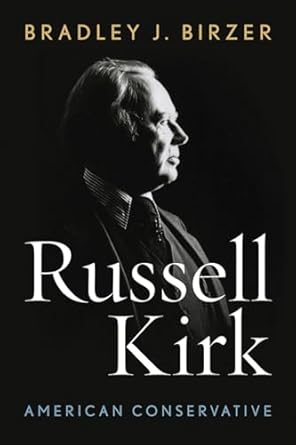
Bradley J. Birzer: Russell Kirk

American Conservative

University Press of Kentucky, 2015

Amazon.com

Emerging from two decades of the Great Depression and the New Deal and facing the rise of radical ideologies abroad, the American Right seemed beaten, broken, and adrift in the early 1950s. Although conservative luminaries such as T. S. Eliot, William F. Buckley Jr., Leo Strauss, and Eric Voegelin all published important works at this time, none of their writings would match the influence of Russell Kirk’s 1953 masterpiece The Conservative Mind. This seminal book became the intellectual touchstone for a reinvigorated movement and began a sea change in Americans’ attitudes toward traditionalism.

In Russell Kirk, Bradley J. Birzer investigates the life and work of the man known as the founder of postwar conservatism in America. Drawing on papers and diaries that have only recently become available to the public, Birzer presents a thorough exploration of Kirk’s intellectual roots and development. The first to examine the theorist’s prolific writings on literature and culture, this magisterial study illuminates Kirk’s lasting influence on figures such as T. S. Eliot, William F. Buckley Jr., and Senator Barry Goldwater – who persuaded a reluctant Kirk to participate in his campaign for the presidency in 1964.

While several books examine the evolution of postwar conservatism and libertarianism, surprisingly few works explore Kirk’s life and thought in detail. This engaging biography not only offers a fresh and thorough assessment of one of America’s most influential thinkers but also reasserts his humane vision in an increasingly inhumane time.

Reviews:

“An extraordinary book. Birzer has written a capacious and deeply humane treatment of an important thinker, writer, and actor who has been largely forgotten by an America that once regarded him as a singular and important voice. This lively and fascinating book will be read and talked about.”  Patrick Deneen, author of Democratic Faith

“Bradley J. Birzer’s Russell Kirk will blow away the stereotypes of what it means to be a conservative in modern America. Kirk’s thinking is sharp, his writing is rich, and the fruits of his imagination retain their power to strike even the most skeptical of readers. Birzer has produced an essential introduction to this towering figure.”  Gary L. Gregg, Mitch McConnell Chair in Leadership, University of Louisville

Russell Kirk: American Conservative [is] a beautifully written and deeply insightful biography…Birzer traces the development of Kirk’s ideas, especially the influence Burke, Dawson, Eliot and (surprise) the political philosopher Leo Strauss. He explores Kirk’s concept of the transcendent, which moved from Stoicism to ‘full communion with the Catholic Church.’ And he considers Kirk’s forays in the public square, not least his association with Barry Goldwater, the 1964 presidential candidate.”  Wall Street Journal

“Given the confused and dispirited state of American conservatism at the present moment, it is high time for a Russell Kirk revival. The very thought of such a revival is appealing, even exhilarating, and the appearance of Bradley J. Birzer’s splendid and exhaustively researched biography of Kirk just might provide the catalyst needed to set it in motion.”  National Review

“Birzer covers it all, from Kirk’s family life and Catholic conversion to his disputes with Jaffa and other Straussians over the meaning of the Declaration of Independence…At last, we have the definitive book about this important, fascinating, and good man.”  Claremont Review

About the Author:

Bradley J. Birzer is Russell Amos Kirk Chair in American Studies and professor of history at Hillsdale College. He is also the second Visiting Scholar of Conservative Thought and Policy, Colorado University–Boulder. He is the author of American Cicero: The Life of Charles Carroll and Sanctifying the World: The Augustinian Life and Mind of Christopher Dawson.

Den Boströmska världsåskådningen: Slutbetraktelser

Av Lawrence Heap Åberg

JOBs inledning     Inledning     Filosofins begrepp     Fenomenologi, 1

Fenomenologi, 2     Läran om människan, 1     Läran om människan, 2

Om Gud och själens odödlighet, 1     Om Gud och själens odödlighet, 2

Om Gud och själens odödlighet, 3     Om Gud och själens odödlighet, 4

Den praktiska filosofin i allmänhet, 1     Den praktiska filosofin i allmänhet, 2

Den praktiska filosofin i allmänhet, 3     Den praktiska filosofin i allmänhet, 4

Etik, 1     Etik, 2     Samhällslära, 1     Samhällslära, 2     Samhällslära, 3

Religionsfilosofi, 1     Religionsfilosofi, 2     Religionsfilosofi, 3

Vi skall nu på följande sätt söka angiva grundtankarna i den Boströmska världsåskådningen.

Den omgivande världen i rum och tid är ett helt av våra förnimmelser och ingenting annat. Men det visar sig vidare, att den, just emedan den existerar i rum och tid, icke är ett väsende i egentlig bemärkelse, och då vi med våra sinnen ej kan komma åt något som icke äger denna karaktär, så är det givet att vi med våra sinnen ej kommer åt tingens innersta väsende, utan blott fatta en företeelse, ett fenomen. Men redan den omständigheten att vi är medvetna om sinnevärldens ofullkomlighet visar att vi är medvetna om en annan och högre art av verklighet, som är fullkomlig. Denna högre verklighet, den som vi ej fattar med våra yttre sinnen utan i känslor av annan och högre art samt i all synnerhet i vår tanke, denna verklighet är icke till i tidens och rummets former, utan den är andlig och evig samt till sitt innersta och egentligaste väsende personlig. Den utgör ett helt av personliga väsenden, levande i och genom varandra och genom Gud, den fullkomliga och absoluta personen. Av denna högre värld är människan till sitt sanna väsende en medlem, ehuru hon även tillhör naturen.

Den sanna verkligheten är också grunden till all människans förpliktelse och dess förverkligande i den sinnliga världen är hennes sanna och absoluta goda. Detta goda bliver också därför redan här på jorden ett personligt liv i personliga förhållanden samt ett liv i Gud, till vilket liv allt det sinnliga och opersonliga bör intaga ett tjänande förhållande. Människans bestämmelse är att genom allt högre och högre livsformer utveckla detta sitt personliga liv, tills hon når den högsta möjliga och tänkbara fullkomlighet.

Med ett ord – det är ej kropparna som utgör det i sanning verkliga, icke sinnligt välbefinnande, som har värde i sig själv, det är personen, som är det i sanning verkliga, och det är det personliga som har absolut värde.

Själv kännetecknar Boström sin världsåsikt som rationell idealism. Med idealism förstår han då den åsikt, enligt vilken det sant varande är icke i rummet, utan i tanken, som rationell åter betecknar han den åsikt som anser att den sinnliga världen ej är den enda och högsta, utan att det också gives en osinnlig värld. Ehuru nu visserligen mellan båda ej ett så strängt samband förefinnes att man icke skulle kunna i huvudsak ansluta sig till den ena åsikten utan att biträda den andra, så är dock ett fullt konsekvent genomförande av den ena omöjligt utan ett lika konsekvent genomförande av den andra. Ty hur läte en osinnlig värld tänka sig om all sann verklighet vore bunden vid rummets form, och hur kan man å andra sidan undgå att tillerkänna det osinnliga verklighet, så framt det verkliga är i tanken, och vi människor dock faktiskt är medvetna om fullkomligheten eftersom vi inser vad ofullkomlighet är? De betänkligheter man i sistnämnda avseende hyst utgår alla från den förutsättningen att det som skall vara verkligt befinner sig utom oss i rummet.

Det påståendet har gjorts, att Boströms läror befunne sig i strid mot den empiriska forskningens resultat. Ett dylikt uppfattningssätt kan ha sin grund i flera omständigheter. Det kan föranledas blott därav att en eller annan av Boströmianismens anhängare ej bemött den empiriska forskningen eller dess målsmän med den aktning de förtjänar, liksom också av dessa senares anspråk på att själva äga något slags monopol på allt vad vetenskaplig forskning heter. I dylika fall kan man blott säga att det första man av varje ärligt strävande att finna sanningen, ja av varje ärligt arbete överhuvud borde lära sig, det är att hysa aktning för andras bemödanden i samma syfte, även om arbetsfältet är ett annat. Självtillräcklighet och förakt för andra hämnar sig nog förr eller senare på den självtillräcklige själv, och det arbete som ej företages i ödmjukhet och under medvetande om den hjälp man av andra behöver, det arbetet kan väl för en tid bära storartade, t. o. m. lysande frukter, men förr eller senare skall det visa sig att, när man isolerar sig från andra, förmenande sig kunna vara dem förutan, då försinar en dag de källådror som skulle nära och vederkvicka det egna strävandet.

Stundom har det nämnda påståendet helt enkelt föranletts av bristande insikt i vad Boström verkligen lärt, stundom åter av motvilja mot det översinnliga i allmänhet och de krav detta ställer på viljan. Men i många fall är det ett uttryck för en så fullkomlig okunnighet och begreppsförvirring beträffande filosofins egentliga uppgift och betydelse, att det ur denna synpunkt är förtjänt av uppmärksamhet.

Antag att någon skulle framkomma med det påståendet att Copernici system strider emot vår dagliga erfarenhet, ty vi ser ju dagligen att solen går både upp och ned. Gjorde denne man anspråk på att betraktas som en i någon mån bildad man, så skulle en naturforskare visst baxna över att höra honom tala på detta sätt. Men säger han sedan själv att en rationellt idealistisk världsåsikt strider mot naturvetenskapens resultat, så använder han själv alldeles precis samma argument och alldeles precis samma grunda synpunkt för sin betraktelse av förhållandena. Det är väl alldeles klart att lika så litet som astronomen någonsin vill neka att för vårt mänskliga öga ter det sig så, att solen går upp och ned, men jorden står stilla, lika så litet kan det falla någon filosof in att bestrida att sinnevärlden är sådan som den vid noggrann iakttagelse befinnes vara. Men liksom naturvetenskapsmannen visar att de företeelser som omedelbart för oss presenterar sig för sin förklaring förutsätter vad som icke i dem omedelbart röjer sig, nämligen att jorden går och solen står stilla, likaså söker filosofen visa att hela den sinnliga världen för sin förklaring förutsätter en osinnlig värld. För uppfattningen av sinnevärlden såsom sådan har detta naturligtvis platt ingen betydelse, och något annat än att göra reda för den, det kan omöjligen vara naturvetenskapens uppgift.

Det tillkommer oss icke här att forska efter de anledningar som förmå visst icke alla men ej så få av de empiriska vetenskapernas, enkannerligen naturvetenskapernas målsmän att sammanblanda från varandra vitt skilda frågor, så att det ser ut som skulle striden mellan dem [Nämligen visst icke alla, ej en gång de flesta som för närvarande föra eller tro sig föra naturvetenskapens talan. Mellan naturvetenskapsmannen såsom sådan och filosofen kan naturligtvis inga konflikter uppstå. Den sanne naturforskaren vet att han såsom sådan ej har det ringaste att göra med filosofins problem eller filosofen med hans, och därför talar han lika litet om någon konflikt mellan de resultat vartill båda kommer som han talar om någon konflikt mellan Linnés sexualsystem och en matematisk kalkyl. LHÅ] och den filosofiska vetenskapens ämnesvänner bero därpå att dessa skulle jäva erfarenhetens vittnesbörd, under det de själva skulle hålla fast vid detta, då det för en var, som har den minsta förmåga att skilja olika frågor från varandra är uppendagligt att frågan gäller: Tolkar den empiriska eller filosofiska vetenskapens målsmän erfarenhetens vittnesbörd rätt? Och gives det en annan erfarenhet än den vars förklaring är de empiriska vetenskapernas uppgift? Icke heller har vi anledning att forska efter hur det kommer sig att mången naturvetenskapsman, då han skall besvara den fråga som föreligger honom i denna egenskap – hur är naturen beskaffad? – i stället för att helt enkelt inskränka sig till att söka lämna bidrag till detta besvarande tror sig böra på samma gång söka svaret på en annan, nämligen: är naturen den enda verkligheten?

Anledningen till detta förhållande, som vållar många missförstånd och många förvecklingar, kan, som vi redan antytt, vara mångahanda, och de ligger väl ej ensamt hos de nämnda målsmännen för de empiriska vetenskaperna. Till en god del kan de sökas i jämförelsevis ursäktliga missförstånd och i vissa hos människan i allmänhet vanliga tendenser. Såvitt vår svenska filosofi blir sin princip trogen kan i hennes lära ingenting ligga som är ägnat att vålla konflikter med den verkligt empiriska forskningens resultat. Ty i denna princip ligger ett strängt fasthållande av skillnaden emellan tvenne arter av verklighet, vilket från en sida sett är ett strängt fasthållande av skillnaden emellan den empiriska och den filosofiska vetenskapens arbetsfält. En världsåskådning sådan som den Hegelska, för vilken den sinnliga verkligheten är den enda, och som vill giva en sida i denna verklighet en absolut betydelse, kan känna sig frestad till intrång på andras ägoområde – en strängt rationell världsåskådning kan det icke. Men skulle man, ehuru man i princip hyllar en sådan lära, likväl ha kvar några empiristiska tendenser, så kan häri en anledning ligga till dylika konflikter. Man kan då i namn av denna sin världsåskådning fordra att sinnevärlden skall äga den eller den formen. Att undersöka huruvida i den Boströmska filosofin någon anledning till ett sådant sätt att gå tillväga förefinnes, tillkommer oss ej här. Därför skulle tarvas en mer detaljerad och mer strängt vetenskaplig redogörelse för denna lära än den vi här lämnat, och dessutom en kritik av densamma, som för vårt nuvarande ändamål är främmande.

Mäktigt har det inflytande varit, som den Boströmska filosofin utövat på vårt folks andliga liv, ett inflytande som sträckt sig även till de kretsar där man ej haft tillfälle att djupare intränga i den filosofiska vetenskapen. För mången av Boströms lärjungar var den snart sagt en religion, och tvivelsutan har den i sin mån, jämte flera andra omständigheter, bidragit att förskona vårt land från sådana läror som t. ex. den moderna pessimismen med flera dylika.

För närvarande har den obestridligen inom flera kretsar råkat i misskredit. Detta beror tydligtvis på flera omständigheter, av vilka vi i inledningen påpekat några. I mycket är dess grund väl även att söka i människors vanliga ombytlighet och benägenhet att överdriva så förtjänster som fel. Många av Boströms beundrare hade uppenbarligen aldrig djupare inträngt i hans läror, och berömmet i deras mun var därför företrädesvis en ytlig jargon, liksom både då och nu tadlet i mången motståndares. En dylik jargon skulle obestridligen i många fall hämma den egna tankens fria flykt och framkalla en reaktion. Dessa och andra liknande företeelser hör till det mänskliga livets vanliga gång. De har visat sig över allt, varhelst ett nytt åskådningssätt av Gud, människa eller natur framträtt. Förhållandet i fråga kan väl även ha sina djupare anledningar.

Vare härmed hur som helst. Inflytandet kvarstår i alla fall och röjer sig även där man minst anar dess tillvaro. Vad som nu ivrigast förkättras, är också mindre Boströms verkliga läror än de vidunderliga vanställningar av dem som är i omlopp. Skulle det försök till en kort framställning av dem som nu lämnas i allmänhetens händer kunna någonstädes skingra ett eller annat av dessa missförstånd eller vända någons tankar till de föremål den behandlar så vore författaren rikligen belönad för det arbete dess författande kostat honom. Med alla de fel den, som varje mänskligt verk, naturligen har – fel som det tillhör vår tid och den följande tiden att genom sorgfällig kritisk prövning inför vetenskapens forum söka upptäcka och rätta – är dock den Boströmska världsåskådningen förtjänt av att ännu en tid få leva i den eftervärlds minne, för vilken den enslige tänkaren arbetade och av vilken han hoppades så mycket.